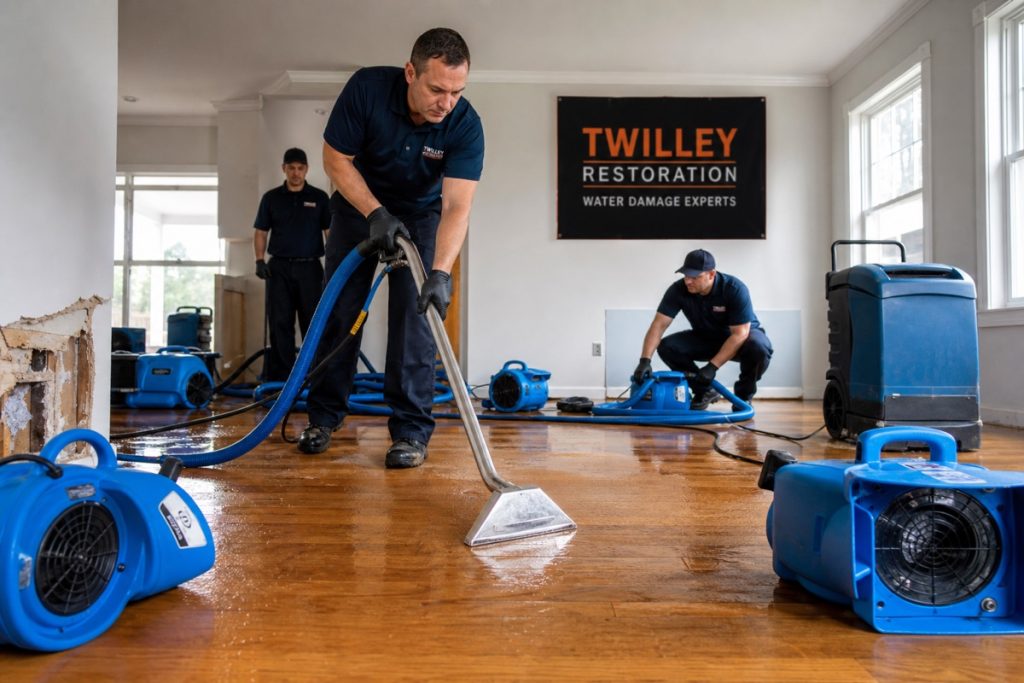
Water mitigation is the emergency work that keeps a water loss from getting bigger: stopping the source, extracting water, pulling out what can’t be saved, and drying the structure. Water restoration (often called reconstruction or repair) is the work that puts the home back: new drywall, paint, flooring, cabinets and trim. Mitigation limits the damage; restoration reverses it.
The words get used loosely. Plenty of companies advertise “water damage restoration” when they mean drying, and some insurers write separate estimates for each phase. Knowing where one ends and the other starts helps you compare bids, manage a claim and avoid rebuilding over wet framing.
Side-by-side
| Mitigation | Restoration / reconstruction | |
|---|---|---|
| Goal | Stop the damage from spreading | Return the home to pre-loss condition |
| When | Immediately, ideally the same day | After the structure is verified dry |
| Typical work | Extraction, removal of wet pad and drywall, antimicrobial treatment, air movers and dehumidifiers, daily moisture readings | Drywall, texture and paint, flooring, baseboards, cabinets, countertops, doors and trim |
| Who does it | Water damage restoration companies, often with IICRC-trained technicians | The same company, or a general contractor or remodeler |
| Typical length | Often a few days of drying | A day to several weeks, depending on scope |
| How it’s priced | Labor, equipment days, removal, disposal; often per square foot by water category | Materials and trade labor; varies with finish level |
What happens during mitigation
- Source control. Shut off the water, cap the line, or tarp the roof.
- Assessment. Moisture meters and thermal imaging map the wet area. The crew determines the category of water and the class of damage under the IICRC S500 standard (see categories and classes explained).
- Extraction. Standing water is removed from floors and carpet.
- Controlled demolition. Carpet pad, swollen baseboard, wet insulation and the lower part of wicking drywall are removed. With sewage or floodwater, more porous material comes out.
- Cleaning and treatment. Surfaces are cleaned and, as needed, treated with antimicrobials.
- Drying and monitoring. Equipment runs while readings are taken daily until materials reach a dry standard.
Speed is the whole point. Mold can start on damp materials within a day or two (the EPA’s guidance is to dry them within 24 to 48 hours), and in a closed-up Houston house in summer, humidity accelerates that. Every day of delay moves material from “dry it in place” to “tear it out,” which shifts cost from the cheap phase to the expensive one. Our structural drying and water extraction pages cover the equipment in more detail.
What happens during restoration
Restoration should start only after the final moisture readings confirm the framing, subfloor and remaining materials are dry. Then the rebuild follows a familiar order: drywall hung, taped and textured; primer and paint; flooring; baseboards and trim; cabinets and countertops if they were removed; final cleaning. If you’re working through insurance, the reconstruction estimate is often reviewed separately from the mitigation invoice. Our water damage repair page explains what that phase involves.
Why the order matters
Closing walls over damp studs, or laying new flooring on a slab that is still wet, traps moisture. The result can be mold behind fresh paint, cupped hardwood, or flooring adhesive that fails, followed by a second tear-out. Before reconstruction starts, ask for:
- the drying log with daily moisture readings,
- the dry standard used (usually a reading compared to unaffected material of the same type),
- photos of open wall cavities before they’re closed.
A reconstruction contractor that is not the company that dried the home should see those records too.
The same logic applies to hidden spaces. Water that ran under kitchen cabinets, behind a tub or into the gap between subfloor layers can read dry at the surface while staying wet underneath. Ask whether those spots were checked with a pin meter or by opening a small inspection hole, not just scanned from the outside.
One company or two?
Both approaches are common. A single company can make the hand-off simpler and keeps one party responsible for the whole result. Separate companies can make sense if you already have a contractor you trust for the rebuild, or if the mitigation company doesn’t do reconstruction. Either way:
- get a separate written scope and itemized estimate for each phase,
- make sure the rebuild contractor receives the drying documentation,
- ask each company for proof of insurance, and ask the mitigation company about IICRC certification,
- if mold is involved, remember that in Texas, mold work on larger areas needs separately licensed assessors and remediators (TDLR).
How insurance treats each phase
For a covered, sudden loss, a Texas homeowners policy typically pays reasonable mitigation costs and the cost to repair the covered damage, minus your deductible. Your policy also expects you to take reasonable steps to protect the property, which is mitigation by another name. Waiting for an adjuster before drying, and letting damage grow, can reduce what the insurer pays for.
Practical points for a claim:
- Photograph everything before removal, and keep the failed part.
- Keep the mitigation company’s moisture logs, photos and invoice; adjusters often compare them line by line.
- Expect the reconstruction estimate to be negotiated separately, sometimes after drying is done.
- A contractor may not waive your deductible in Texas (Business and Commerce Code Sec. 27.02) and may not act as your public adjuster (Insurance Code Sec. 4102.163).
See what Texas homeowners insurance covers and how to file a water damage claim in Texas.
Cost and time, in short
Mitigation is usually the smaller and faster phase; reconstruction is where most of the money and calendar time go, particularly after a flood. Our cost guide lists published price ranges for both, and our guide to how long restoration takes breaks down the stages.
If water is in the house now, the mitigation clock is already running. Call (713) 422-2550 and you’ll be connected with an independent local restoration company that can assess the damage and start drying.
Sources: IICRC S500 standard · EPA: ten things to know about mold · TDI: water damage and home insurance
Frequently asked questions
What is the difference between water mitigation and water restoration?
Mitigation is the emergency extraction, removal and drying that stops damage from spreading. Restoration is the rebuild afterward: drywall, paint, flooring and cabinets.
Which comes first?
Mitigation, always. Rebuilding before the structure is verified dry can trap moisture and lead to mold or failed flooring.
Is water mitigation covered by insurance in Texas?
For a covered sudden loss, reasonable mitigation costs are usually part of the claim, and policies expect you to take steps to prevent further damage. Flood needs a separate flood policy.
Do I need the same company for both phases?
No. One company can handle both, or a separate contractor can rebuild. Get separate written scopes and make sure the rebuild contractor sees the drying records.
How long does mitigation take?
Commonly a few days of drying after extraction, longer for hardwood, plaster, wet slabs or jobs that started late.
Water damage in your home right now?
Don't wait for it to spread. Call and we'll connect you with an available local company.
Call (713) 422-2550More Houston water damage guides
Water spreading right now? Don't wait.
Every hour costs you more in damage. Call now and we'll connect you with a local crew.