Appliance Leak Water Damage Help in Houston
A failed washer hose, dishwasher, ice-maker line or water heater can soak cabinets and subfloor before anyone notices. Call and we'll connect you with an independent local company to dry out what the appliance left behind.
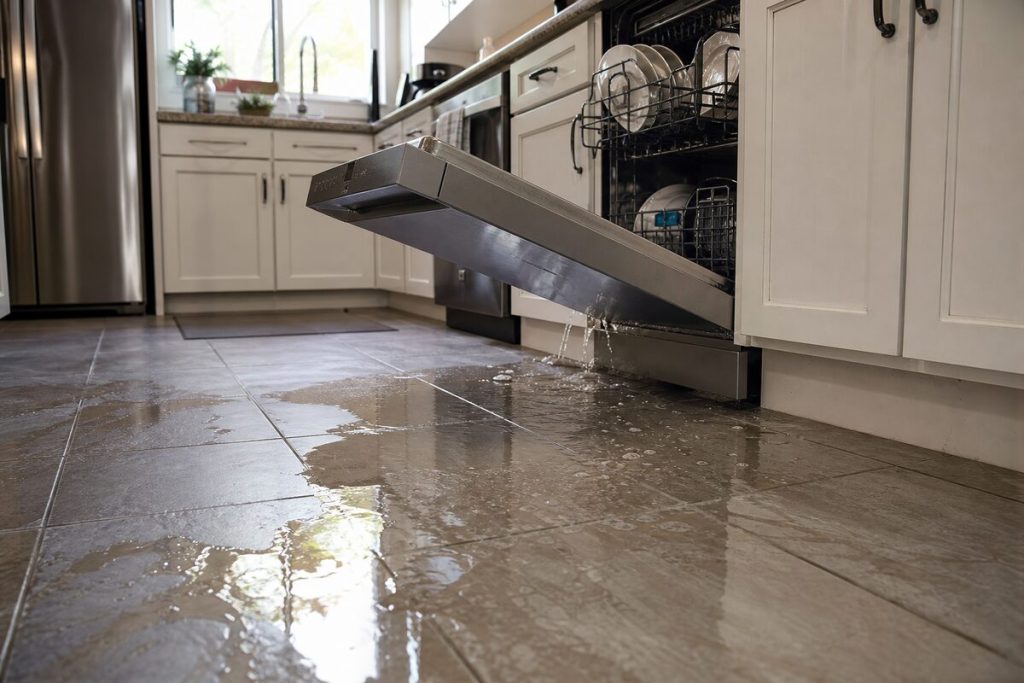
Appliance leaks are among the most frequent water damage calls in any city, and they have one thing in common: the water starts somewhere you can't see. It runs behind the unit, under the cabinet toe-kick and along the subfloor before it reaches the open floor. If the leak has been stopped and you're looking at warped flooring, swollen cabinet bottoms or a wet wall behind the laundry, this page covers what the drying job involves and how to hire for it. If the water is still on the floor right now, start with our step-by-step on what to do first when a washer or dishwasher floods.
Which appliance leaked? What the damage usually looks like
| Source | Typical failure | Where the water ends up |
|---|---|---|
| Washing machine | Burst rubber supply hose, drain hose pulled from the standpipe, overflowing drain box | Laundry floor, the wall behind the washer, adjoining hallway or garage; ceilings below if the laundry is upstairs |
| Dishwasher | Supply line under the sink, door gasket, drain hose, pump seal | Under the dishwasher, sink base cabinet, kitchen subfloor and the cabinet run next to it |
| Refrigerator | Cracked plastic ice-maker or water-dispenser line | Slow seep behind and under the fridge, often under wood or laminate for weeks |
| Water heater | Corroded tank, failed relief valve or fittings | Garage or closet floor, adjoining walls; attic units can damage the ceiling below |
| Ice maker / wet bar / filtration system | Loose compression fittings, aging supply tubing | Inside cabinets and behind walls |
Water heaters have their own checklist; see water heater leaking: what to do.
What the drying company actually does
The difference between a mop-and-fan cleanup and a professional dry-out is mostly about the places nobody looks. A thorough company will:
- Map moisture with pin and non-invasive meters across the floor, up the walls and into neighboring rooms, so the scope matches the real wet area, not the visible puddle.
- Pull the toe-kick on base cabinets, or drill small vent holes, to get air into the sealed space underneath. This is where kitchen leaks hide.
- Decide what to remove. Laminate and many floating floors trap water and often have to come up. Swollen particleboard cabinet bottoms don't recover. Solid wood and tile can often be dried in place.
- Run dehumidifiers and air movers sized to the space, and record readings every day until materials reach a dry standard.
- Check for early mold in long-running leaks, especially behind refrigerators and under sinks.
Moving a fridge, washer or dishwasher is part of the job. Ask whether the company disconnects and reconnects appliances or whether you need a plumber for that.
Repair the appliance, or just the house?
Two separate things need fixing: the appliance (or its hose, valve or tank) and the house. A restoration company handles the house: extraction, drying and, if they do rebuild, flooring, cabinets and drywall. The appliance itself goes to an appliance tech or plumber. Many homeowners replace all rubber washer hoses with braided stainless ones at this point, and add a leak sensor or automatic shutoff valve behind the washer, dishwasher and water heater.
Insurance and appliance leaks
The Texas Department of Insurance uses a broken washer hose as an example of the sudden and accidental water damage most homeowners policies cover. What they generally don't cover: a slow leak that went on for weeks (a common fight with ice-maker lines) and the cost of repairing or replacing the appliance itself. That's why the first photos and the drying company's moisture logs matter. If an adjuster pushes back, our guide to a denied water damage claim explains your options.
Hiring checklist
- Ask for proof of liability insurance and whether technicians hold IICRC water damage (WRT) certification.
- Get a written scope that separates drying from rebuild work.
- Ask for daily moisture readings and photos you can forward to your adjuster.
- Read anything you sign; don't hand over your insurance claim without understanding an assignment of benefits.
Sources: Texas Department of Insurance: When are water damage and mold covered? · CDC: Homeowner's and renter's guide to mold cleanup
Frequently asked questions
My fridge line leaked under the wood floor. Can the floor be saved?
Sometimes. Solid hardwood caught early can often be dried with specialized floor-drying mats. Engineered wood and laminate that have cupped or swelled at the seams usually need replacing. A moisture map tells you how far the water went.
Do kitchen cabinets have to come out after a dishwasher leak?
Not usually. Pulling the toe-kick and drying the space underneath often saves them. Cabinets with swollen particleboard bottoms or mold are the exception.
The washer is upstairs and the ceiling below is wet. Who handles that?
The same drying company should handle both floors. Ceilings below upstairs laundry rooms often hold more water than they show; see our ceiling water damage page.
How long does drying take after an appliance leak?
For a contained kitchen or laundry leak caught quickly, active drying often takes a few days. It's done when the readings say it's dry, not after a set number of days.
Related services
Independent local crews. Ask the right questions.
Independent local companies
Rapid Dry Houston is a referral service. We connect you with independent restoration companies that serve your area; they inspect, quote and do the work.
Check licenses & insurance
Before work starts, ask any crew for proof of insurance and its IICRC certifications (S500 water, S520 mold, S700 fire & smoke). Reputable companies share them gladly.
Get the scope in writing
Ask for a written scope and an itemized estimate before work begins, plus moisture readings that show the structure is actually dry before the job is called done.
Document for insurance
Photos, moisture logs and a line-item estimate in the format adjusters expect keep a claim moving. Ask the crew to provide them, and keep your own photos too.
Appliance leak soaked the floor or cabinets?
Call and we'll connect you with an independent local company that can find the hidden moisture and dry it out.