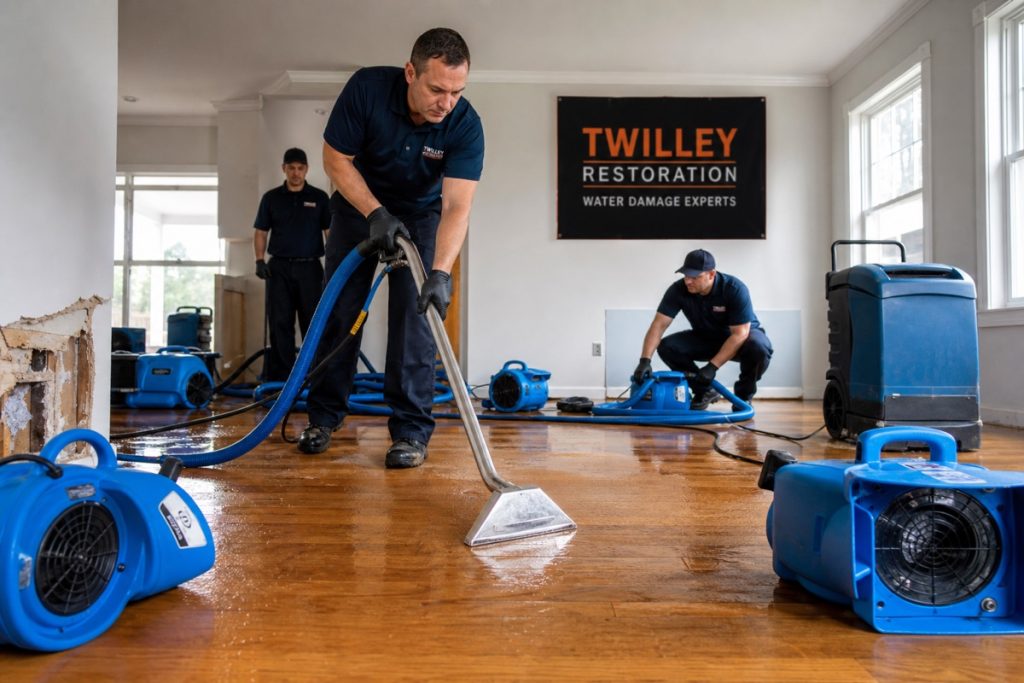
For a typical clean-water leak in a Houston home, the drying phase commonly runs about three to five days once equipment is set, and repairs take anywhere from a day to several weeks after that. Those are common ranges, not promises. The real timeline depends on what got wet, how dirty the water was, whether mold or asbestos testing is needed, how quickly the insurer responds, and whether permits are required.
Here is how a water damage job usually unfolds, stage by stage, with the things that stretch each stage out.
A stage-by-stage timeline
| Stage | Typical length | What can extend it |
|---|---|---|
| 1. Stop the source, first response | Hours | Plumber availability; slab or wall leaks that must be located |
| 2. Inspection and extraction | Same day to one day | Large areas, Category 3 water needing containment |
| 3. Removal of unsalvageable materials | Same day to two days | Asbestos testing on older materials, large cabinet runs |
| 4. Structural drying with daily monitoring | Often 3 to 5 days | Hardwood, plaster, wet slab, high humidity, late start |
| 5. Insurance review of the reconstruction estimate | Days to weeks | Missing documents, adjuster backlog after a storm |
| 6. Reconstruction | One day to several weeks | Scope, material lead times, permits, floodplain rules |
Stage 1 and 2: the first day
The first goal is to stop new water. That might mean closing a valve, capping a broken supply line, or tarping a roof. Then a restoration crew inspects with moisture meters and thermal imaging to find where the water traveled, sets the category and class (see water damage categories and classes), and extracts standing water. Most of this happens in the first visit.
Because the EPA’s mold guidance centers on getting things dry inside a 24-to-48-hour window, the time between the leak and the first visit is the part of the timeline you have the most control over. If you need a company on site, call (713) 422-2550 and we’ll connect you with an independent local restoration company.
Stage 3: removing what can’t be saved
Wet carpet pad, swollen particleboard, saturated insulation and the lower section of drywall that wicked water are typically removed, especially with gray or black water. Removal also opens wall cavities so air can reach the framing, which shortens the drying stage.
One possible delay: in older homes, drywall joint compound, textured ceilings and some flooring may need to be tested for asbestos before they’re disturbed. Waiting on a lab adds time but is the correct order.
Stage 4: drying
Air movers push air across wet surfaces and dehumidifiers pull the moisture out of the air. A good crew takes readings every day and keeps equipment running until materials reach a dry standard, usually measured against unaffected material of the same type in the house. Drying ends based on readings, not the calendar.
What lengthens it:
- Dense materials. Hardwood, plaster, brick and concrete hold water deeper (Class 4) and release it slowly. Site-finished hardwood can take noticeably longer than drywall.
- A wet slab. Most Houston-area homes sit on concrete slabs, which absorb water and can keep flooring adhesive and bottom plates damp.
- Humidity. If the home’s air conditioning is off, Gulf Coast summer air works against the dehumidifiers.
- Hidden water. Water under cabinets, inside wall cavities or between floor layers takes longer to find and dry.
- A late start. Water that sat several days has spread further, often requires more removal, and may have started mold.
More detail on equipment and dry standards is on our structural drying page.
If mold shows up
If mold is found, the timeline can grow. In Texas, mold assessment and remediation on areas of 25 contiguous square feet or more must be performed by companies licensed by the Texas Department of Licensing and Regulation, and the assessor and remediator on a project must be different companies. That means an assessment, a written protocol, remediation, and a clearance check before rebuilding. Ask any company involved for its TDLR license number. Our guide to how fast mold grows after water damage covers the warning signs.
Stage 5: the insurance pause
Many homeowners are surprised that the longest wait is often between drying and rebuilding. If you are claiming, the insurer reviews the reconstruction estimate before approving it. Texas Insurance Code chapter 542 gives an insurer 15 business days after it has everything it requested to accept or reject a claim, and it can take up to 45 more days if it explains in writing why it needs them. After a declared weather catastrophe those deadlines extend by 15 days. Sending complete documentation early (photos, moisture logs, itemized estimate) shortens this stage. Our guide to filing a water damage claim in Texas explains the deadlines in full.
Stage 6: reconstruction
Rebuild time depends on scope:
- Small: a patch of drywall, texture and paint in one room. Often a day or two of work spread over several days to let mud and paint dry.
- Medium: two feet of drywall around a kitchen and living room, new baseboards, paint and flooring. Commonly one to three weeks.
- Large: a flooded first floor, with cabinets, flooring, doors and trim throughout. Several weeks or more, especially if cabinets or matching flooring must be ordered.
Permits and floodplain rules
Repairs inside the City of Houston can require permits, and homes in the mapped floodplain that are substantially damaged, meaning repair costs equal or exceed 50% of the structure’s pre-damage market value, must meet the city’s floodplain ordinance (Chapter 19) before they can be fully rebuilt. That can add weeks or require elevation. Check with the Houston Permitting Center, or your own city if you are outside Houston, before reconstruction starts.
Can you live in the house during restoration?
Often yes for a single-room clean-water loss, though drying equipment is noisy and runs around the clock. With sewage, widespread flooding, mold remediation or no working kitchen, it’s usually safer to stay elsewhere. Many homeowners policies include additional living expense coverage when the home is unlivable after a covered loss; check your policy’s “loss of use” section.
How to keep the timeline short
- Shut off the water and start extraction the same day.
- Report the claim promptly and send documentation as you get it.
- Keep the air conditioning running if it’s safe to, to help dehumidifiers.
- Ask the restoration company for daily readings so you know when drying will end.
- Choose flooring and cabinets early if they need to be ordered.
For the difference between the drying work and the rebuild, see water mitigation vs. restoration.
Sources: EPA: ten things to know about mold · Texas Insurance Code Sec. 542.056 · City of Houston: repairing flood damage in the floodplain
Frequently asked questions
How long does it take to dry out a house after water damage?
For many clean-water losses, about three to five days of drying once equipment is in place. Hardwood, plaster, wet slabs and late starts can extend that. Drying should end when moisture readings reach a dry standard.
Why is my restoration taking weeks?
Usually because of the rebuild stage: insurance approval of the estimate, ordering cabinets or flooring, permits, or mold remediation. The drying itself is typically the shorter part.
Does mold add time to water damage restoration?
Yes. Larger mold jobs in Texas require a licensed assessor, a remediation protocol, licensed remediation and a clearance check before rebuilding.
Can I stay in my home during water damage restoration?
Often for a small clean-water job. For sewage, major flooding or mold work it’s usually better to stay elsewhere. Check whether your policy includes additional living expenses.
Do I need a permit to repair water damage in Houston?
Some repairs do, and substantially damaged homes in the floodplain must meet Chapter 19 floodplain rules. Check with the Houston Permitting Center before rebuilding.
Water damage in your home right now?
Don't wait for it to spread. Call and we'll connect you with an available local company.
Call (713) 422-2550More Houston water damage guides
Water spreading right now? Don't wait.
Every hour costs you more in damage. Call now and we'll connect you with a local crew.