Structural Drying & Water Mitigation in Houston
Once the standing water is gone, the walls, framing, cabinets and slab are still wet inside. Call and we'll connect you with an independent Houston company that dries the structure and measures it until it's done.
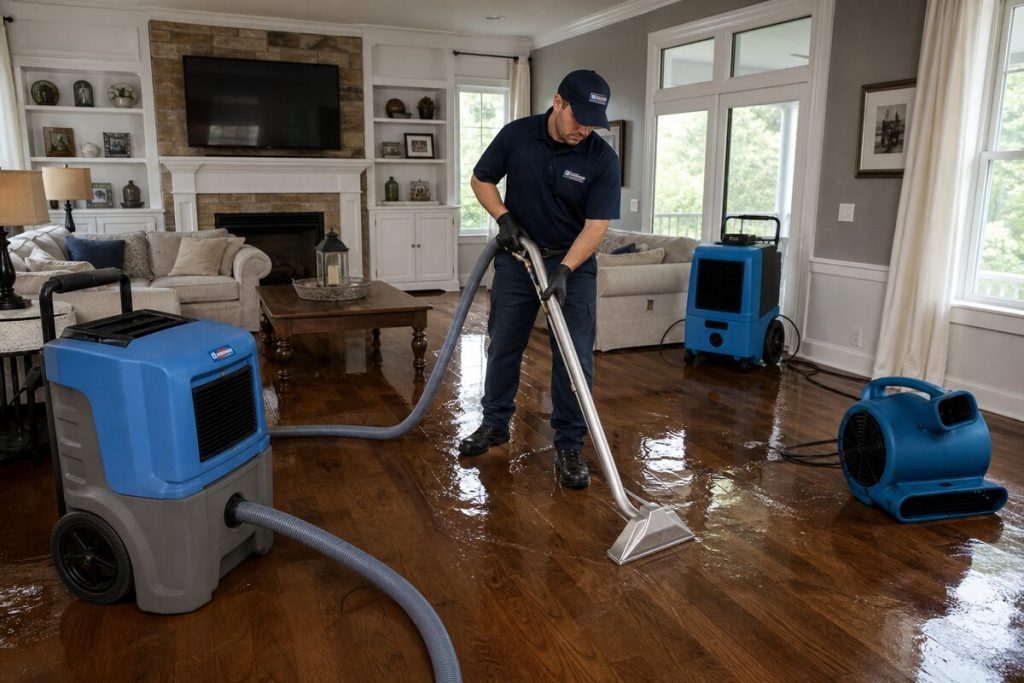
Structural drying is the part of water damage restoration you can't see. A floor can look dry and feel dry while the bottom plate of the wall, the drywall above the baseboard and the concrete slab still hold enough moisture to grow mold or swell new flooring weeks later. Structural drying means controlling the air in the affected area so water evaporates out of building materials, and taking measurements to prove they're dry before anyone closes the job. If you're comparing companies or wondering why there are noisy machines in your living room for four days, this page explains what they should be doing.
What water mitigation means (and how it differs from restoration)
You'll hear restoration companies and adjusters use the term water mitigation. It means the work done to stop water damage from getting worse, as opposed to restoration or repair, which puts the house back together afterward. Mitigation usually includes:
- Stopping the source and making the area safe.
- Extracting standing water from floors, carpet and pad.
- Removing materials that can't be dried or cleaned, such as soaked pad, swollen baseboards and wet insulation.
- Cleaning, and applying antimicrobial treatment where the water was contaminated.
- Structural drying with dehumidifiers and air movers, monitored with daily moisture readings until the drying goal is met.
Restoration is what comes after mitigation: replacing drywall and insulation, installing new flooring, rebuilding cabinets, painting, and any permitted structural, plumbing or electrical work. The two phases differ in a few practical ways:
- Timing. Mitigation is urgent and starts within hours; restoration can wait until the structure is confirmed dry, the scope is agreed and permits are in hand.
- Who does it. Mitigation is done by water damage technicians with extraction and drying equipment. Restoration is construction work, done by the same company's rebuild crew or by a separate general contractor.
- How it's priced. Mitigation is usually billed by equipment, labor and drying days. Restoration is billed like a remodel: materials, square footage and trades.
- What goes wrong. Rushed mitigation leaves hidden moisture behind. Rushed restoration closes walls over it.
Structural drying is usually the longest part of mitigation and the part most often cut short. Insurers commonly treat mitigation as its own invoice, separate from the rebuild, and that invoice is typically built on equipment counts, drying days and the moisture log. That's why the documentation described below matters so much. For a side-by-side comparison, see our guide to water mitigation vs. restoration.
The basic idea: move, remove, measure
Drying depends on three things working together:
- Air movement. Air movers (the low, snail-shaped fans) blow across wet surfaces to speed up evaporation from drywall, carpet and wood.
- Dehumidification. Evaporated water ends up in the air. Dehumidifiers pull it out and pump it down a drain, so the air stays "thirsty" and can keep absorbing more.
- Measurement. Readings taken at every visit show whether the materials are actually drying and when they've reached the goal.
Fans without dehumidifiers just push humid air around, which in a closed Houston house can raise the humidity everywhere and spread the problem to rooms that were never wet.
Why Houston's climate changes the approach
In many parts of the country you can open the windows to dry a house. In Houston that usually backfires: summer dew points here routinely sit in the 70s °F, so outdoor air is already loaded with moisture. Most drying in Houston is done as a closed drying chamber: windows and doors shut, plastic sheeting sometimes used to wall off the wet area, and dehumidifiers doing the work. After a hurricane or major storm, power outages add a second problem, because dehumidifiers and air movers need electricity. Ask the company how they'll handle drying if power is out, and never run a generator inside the house or garage.
Measuring moisture: what technicians check
- Pin moisture meters push two small pins into drywall, wood or baseboard to read moisture content at a specific point.
- Pinless (non-invasive) meters scan through surfaces like tile, vinyl and painted walls to map where moisture is without making holes.
- Thermo-hygrometers measure air temperature and relative humidity and calculate grains per pound (GPP), the actual weight of water vapor in the air. Comparing GPP in the wet room, at the dehumidifier exhaust and outdoors tells the technician whether the equipment is working.
- Thermal (infrared) cameras show cooler, evaporating areas that point to hidden moisture. They guide the meter; they don't replace it.
Drying goals: how "dry" is decided
"Dry" doesn't mean zero moisture. Every material holds some water normally. A good technician takes readings from the same material in an unaffected part of your home (a "dry standard") at the start, then dries the wet materials until they match it. That target is the drying goal. Readings should be recorded on a moisture map or log at every visit, room by room, with the equipment count and the GPP readings. Ask for a copy: it's evidence for your insurance claim and protects you if a problem shows up later.
IICRC S500: the standard to ask about
The ANSI/IICRC S500 Standard for Professional Water Damage Restoration is the industry's published standard of care for water damage work. It covers water categories (how contaminated the water is), classes of water loss (how much water and how hard it is to evaporate), drying goals, equipment placement and documentation. You don't need to read it, but you can ask any company: "Do you follow the S500, and will you give me your daily moisture readings?" A confident yes to both is a good sign.
The S500's four classes help explain why some jobs take longer:
| Class | What it means |
|---|---|
| Class 1 | A small area, with little water absorbed into materials. |
| Class 2 | Water has wicked into carpet, pad and the lower part of walls. |
| Class 3 | Most of the area is saturated, often from overhead (ceilings, insulation, walls). |
| Class 4 | Water has soaked into dense materials that release it slowly: hardwood, concrete, plaster, stone. These need specialty drying methods and more time. |
Equipment you might see
Low-grain refrigerant (LGR) dehumidifiers are the workhorses of residential drying and keep pulling water out even as the air gets drier. Desiccant dehumidifiers use a moisture-absorbing wheel instead of cold coils and are useful in cooler spaces and for drying dense materials. Wall cavity drying systems push dry air through small holes behind baseboards, so the drywall can sometimes be saved instead of cut out. Hardwood floor mats pull moisture up through the boards under suction. Heat drying raises material temperature to speed evaporation and is sometimes used on hard-to-dry assemblies.
How long drying takes
For a typical clean-water loss caught quickly, drying often takes three to five days. Hardwood, concrete, plaster, multi-story leaks and late starts take longer. A company that pulls equipment before readings reach the drying goal is cutting a corner. One that leaves it running for two weeks without showing progress should be asked why. Drying starts after water extraction and ends before repairs and rebuilding. Skipping the measurement step is how new drywall ends up closed over wet framing. For the timeline of the whole job from first call to final repairs, see how long water damage restoration takes.
Getting connected
We don't own equipment or send crews. When you call (713) 422-2550, we connect you with an independent local restoration company. Ask them for proof of insurance, their IICRC Water Damage Restoration Technician or Applied Structural Drying certifications, and copies of the daily moisture logs.
Sources: IICRC: ANSI/IICRC S500 Standard · National Weather Service Houston/Galveston
Frequently asked questions
Is water mitigation the same thing as water damage restoration?
Not quite. Mitigation is the emergency work that limits damage: extraction, removing ruined materials and drying. Restoration usually refers to the whole job, including the repairs that come after. Some companies do both; others only mitigate and hand the rebuild to a contractor.
Can I turn off the drying equipment at night because of the noise?
Ask first, but generally no. Drying works around the clock, and switching dehumidifiers off lets humidity climb back up, which slows everything down. If the noise is a problem, ask the company whether equipment can be rearranged or the work area sealed off.
Why is my electric bill higher during drying?
Dehumidifiers and air movers use a noticeable amount of power over several days. Some insurers reimburse that extra electricity as part of the claim. Note your meter reading on the first and last day, and ask your adjuster.
Should I leave windows open to help things dry?
In Houston, usually not. Outdoor air is often more humid than the air the dehumidifiers are producing, so open windows can slow drying down. Follow the technician's advice for your specific job.
How do I know the walls are really dry?
Ask for the moisture log. It should show readings for each wet area compared to a dry reference in your home, with dates. When the wet areas match the reference, the drying goal has been met.
Does structural drying prevent mold?
Drying materials quickly is the most effective way to prevent mold after water damage. If materials stay wet too long, mold can start to grow. If you already see or smell mold, mention it, because larger mold problems in Texas must be handled by separately licensed mold professionals.
Related services
Independent local crews. Ask the right questions.
Independent local companies
Rapid Dry Houston is a referral service. We connect you with independent restoration companies that serve your area; they inspect, quote and do the work.
Check licenses & insurance
Before work starts, ask any crew for proof of insurance and its IICRC certifications (S500 water, S520 mold, S700 fire & smoke). Reputable companies share them gladly.
Get the scope in writing
Ask for a written scope and an itemized estimate before work begins, plus moisture readings that show the structure is actually dry before the job is called done.
Document for insurance
Photos, moisture logs and a line-item estimate in the format adjusters expect keep a claim moving. Ask the crew to provide them, and keep your own photos too.
Walls, floors or cabinets still wet?
Call and we'll connect you with an independent Houston drying company.