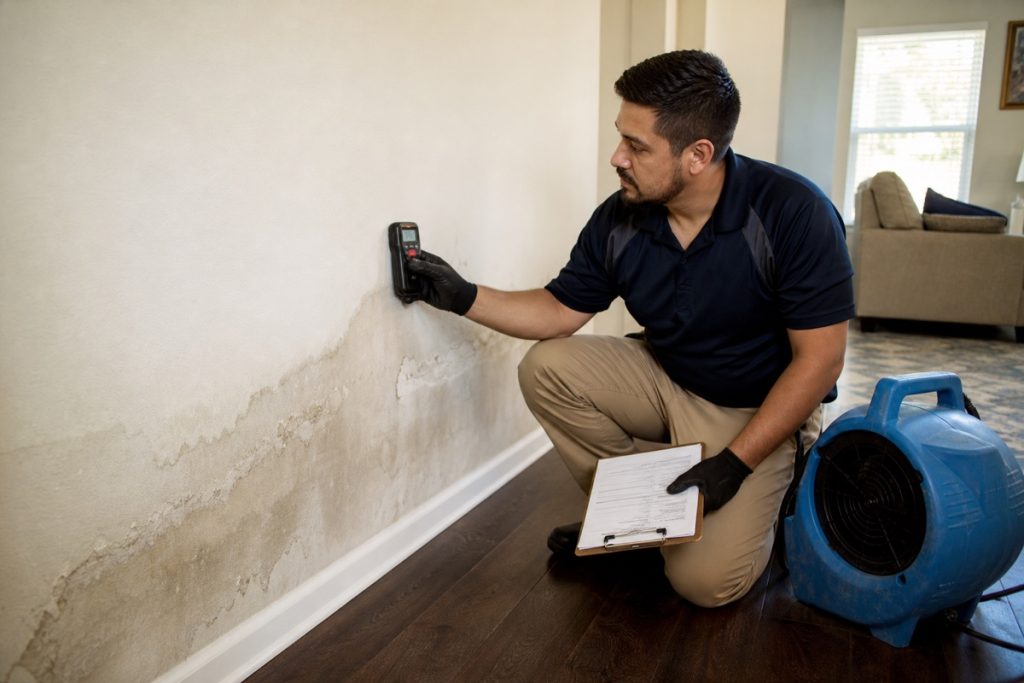
Water damage restoration in Houston has two separate bills, and most confusion about cost comes from mixing them up. The first is mitigation: extracting the water and drying the structure. The second is reconstruction: replacing the drywall, flooring and cabinets that could not be saved. A clean-water leak caught the same day may only need the first. A flooded slab-on-grade ranch in Meyerland or Kingwood almost always needs both.
Below are the published national price ranges, what pushes a Houston job toward the top or bottom of them, and how to read an estimate. Treat every number here as a starting point. Actual prices vary by company, by the size and age of the home, by the type of water, and by how quickly drying begins.
Water damage restoration cost: typical ranges (national data)
Cost-guide publishers survey contractors and average the results. Their figures are national, not Houston-specific, and they differ from one another, so look at them as a band rather than a quote:
| Item | Published range | Source |
|---|---|---|
| Typical restoration job (mitigation plus basic repair) | $1,200 to $5,000; national average about $3,000 | Fixr, updated Jan 2025 |
| Extraction and drying, clean water (Category 1) | $3.75 to $4.25 per sq ft | Fixr |
| Extraction and drying, gray water (Category 2) | $4.10 to $6.50 per sq ft | Fixr |
| Extraction and drying, black water (Category 3) | $7.00 to $7.50 per sq ft | Fixr |
| Full water damage repair (reconstruction) | Starts at $20.85 to $38.25 per sq ft | Homewyse, Sept 2026 |
The gap between the drying rate (single dollars per square foot) and the repair rate (twenty-plus dollars per square foot) is the most useful thing in that table. It tells you that the cheapest outcome is almost always the one where more material is dried in place and less is torn out.
What moves a Houston job up or down
Water category
The industry standard, ANSI/IICRC S500, sorts water by contamination. Clean water from a supply line is mostly an extraction-and-drying job. Gray water from a washing machine or dishwasher needs cleaning and some removal of porous material. Black water, which includes sewage and floodwater from bayous, creeks or streets, means wet carpet, pad and lower drywall generally come out and the area is disinfected. That is why the per-square-foot rate roughly doubles from Category 1 to Category 3. Our guide to water damage categories and classes explains how a crew decides which applies.
How long the water sat
The EPA advises drying water-damaged materials within 24 to 48 hours to prevent mold growth in most cases. In Houston’s humid air that window matters. A job that starts on day one is mostly fans and dehumidifiers. A job that starts on day four often adds mold work, more demolition, and a longer rebuild.
Materials and the age of the house
Tile on a concrete slab usually survives. Carpet pad, the bottom of drywall, insulation and particleboard cabinet boxes usually do not once soaked. Site-finished hardwood and plaster in older Heights or Montrose homes take longer to dry and cost more to replace. Older homes may also need materials tested for asbestos before demolition, which adds time and a lab fee.
Mold
If mold covers 25 contiguous square feet or more, Texas requires the assessment and remediation to be done by companies licensed by the Texas Department of Licensing and Regulation (TDLR), and the assessor and the remediator cannot be the same company on the same project. That separation adds a second invoice. Ask any company for its TDLR license number before mold work starts.
Floodplain rules
Inside the City of Houston, a home in the mapped floodplain that suffers substantial damage (repair cost equal to or more than 50% of the structure’s pre-damage market value) must be brought into compliance with the city’s floodplain ordinance, Chapter 19, before it is fully rebuilt. That can mean elevation, not just new drywall. It does not change mitigation cost, but it can change the reconstruction bill dramatically after a flood.
Water damage repair cost (reconstruction)
Once the moisture readings show the structure is dry, the second phase begins: putting back what was removed. This is the part of the bill that varies most, because it depends on finish level as well as square footage. Fixr publishes these typical ranges for common repairs:
| Repair | Typical range |
|---|---|
| Drywall repair (one area) | $275 to $485 |
| Subfloor repair | $250 to $750 |
| Ceiling repair | $325 to $1,100 |
| Hardwood flooring repair | $600 to $2,000 |
| Mold remediation | $1,500 to $4,000 |
Those are per-area figures. A flooded first floor multiplies them: every room may need the lower two or four feet of drywall replaced, new baseboards, paint, flooring throughout, and lower kitchen cabinets. Matching existing finishes (a discontinued tile, a stained trim color, a run of hardwood that has to blend with rooms that stayed dry) pushes the price up further.
Why the cheapest rebuild bid can cost more
A low reconstruction bid sometimes skips the step that protects everything else: confirming the framing and subfloor are dry before closing walls. Drywall hung over wet studs traps moisture, and the result is often mold or warped flooring within months, followed by a second tear-out. Ask how dryness will be verified, and ask for the final moisture readings in writing.
Mitigation and reconstruction are often different companies
Some restoration companies do both phases. Others dry the home and hand off to a general contractor or remodeler. Neither approach is wrong, but each phase should have its own written scope and itemized estimate so you, and your insurer, can see what each one covers. Our explanation of mitigation versus restoration walks through the hand-off.
Where the money goes on a mitigation invoice
- Emergency service call and extraction with truck-mounted or portable extractors.
- Equipment days: air movers, dehumidifiers and sometimes air scrubbers, billed per unit per day. This is the line that grows when drying starts late.
- Controlled demolition of carpet pad, wet drywall, baseboards and insulation.
- Antimicrobial treatment, more extensive for Category 2 and 3 water.
- Monitoring visits to take daily moisture readings.
- Disposal of removed materials.
Most restoration estimates are written in Xactimate, estimating software that is also widely used by insurance adjusters, which makes it easier to compare line by line with the adjuster’s numbers.
How insurance changes your out-of-pocket cost
In Texas, a standard homeowners policy typically covers sudden and accidental water damage, such as a burst pipe or a failed water heater, minus your deductible. It does not cover flooding from rising water, which needs a separate flood policy, and it usually excludes gradual leaks and seepage. For the details, see whether homeowners insurance covers water damage in Texas. If you plan to claim, document everything before removal and read our step-by-step guide to filing a water damage claim in Texas.
One Texas rule worth knowing: under Texas Business and Commerce Code section 27.02, a contractor who expects to be paid from insurance proceeds may not waive, absorb or rebate your deductible. An offer to “cover your deductible” is a red flag.
How to keep the bill reasonable
- Stop the source and start drying fast. Shut the main valve. Every day of delay adds equipment days and demolition.
- Get the scope in writing before work starts. What will be removed, what will be dried in place, and why.
- Ask what ends the drying. The answer should be moisture readings reaching a dry standard, not a fixed number of days.
- Insist on an itemized estimate rather than a lump sum.
- Ask for proof of insurance and IICRC certification, and a TDLR mold license if mold is involved.
If you need a company on site, call (713) 422-2550 and we’ll connect you with an independent local restoration company that can inspect the damage and give you a written scope. Many companies inspect for free; ask when you call. For what happens next, see water damage cleanup and water damage repair.
Sources: Fixr water damage restoration cost guide · Homewyse repair cost data · EPA: ten things to know about mold · City of Houston: repairing flood damage in the floodplain
Frequently asked questions
How much does water damage restoration cost in Houston?
There is no single Houston price. National cost guides put a typical job between roughly $1,200 and $5,000, with drying billed at about $3.75 to $7.50 per square foot depending on water category, and reconstruction at $20 or more per square foot. Your number depends on the category of water, the area affected and how soon drying started.
Why is sewage or floodwater cleanup so much more expensive?
Category 3 water carries bacteria and other contaminants, so porous materials it touched are usually removed rather than dried, crews wear protective equipment, and the area is disinfected. More demolition means more reconstruction afterward.
Is repair priced separately from drying?
Usually. Mitigation (extraction and drying) and reconstruction (drywall, flooring, cabinets, paint) are separate phases, often with separate estimates and sometimes separate companies.
Can a contractor pay my insurance deductible for me?
No. Texas Business and Commerce Code section 27.02 prohibits a seller who expects payment from insurance proceeds from waiving, absorbing or rebating the deductible.
What makes a flood repair in the Houston floodplain cost more?
If repairs equal or exceed 50% of the home’s pre-flood market value, the City of Houston treats it as substantially damaged, and the rebuild must meet floodplain rules, which can include elevating the structure.
Water damage in your home right now?
Don't wait for it to spread. Call and we'll connect you with an available local company.
Call (713) 422-2550More Houston water damage guides
Water spreading right now? Don't wait.
Every hour costs you more in damage. Call now and we'll connect you with a local crew.