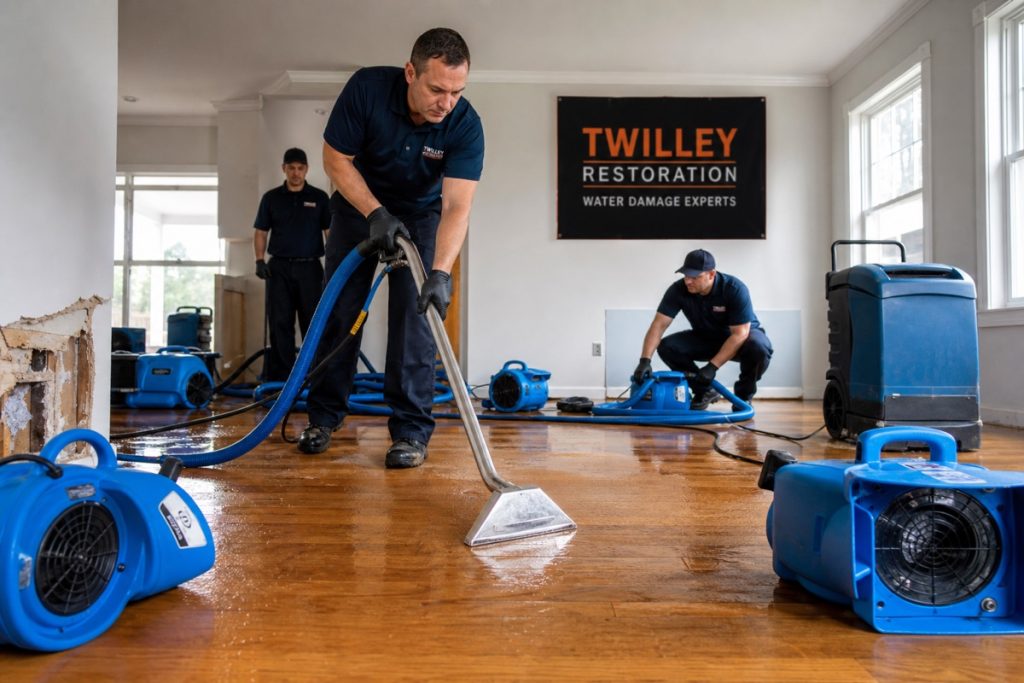
When a restoration company looks at a wet house, it is answering two separate questions. How dirty is the water? That’s the category, numbered 1 to 3. How much water soaked into the building, and into what? That’s the class, numbered 1 to 4. Both come from ANSI/IICRC S500, the Standard for Professional Water Damage Restoration published by the Institute of Inspection, Cleaning and Restoration Certification. The current edition is the fifth, published in 2021.
Category drives safety and what gets thrown away. Class drives how much drying equipment is needed and for how long. Knowing both helps you read an estimate and ask good questions.
The three categories of water damage
Category 1: clean water
Water from a sanitary source that does not pose a substantial risk if touched or swallowed. Typical examples: a broken supply line, a leaking faucet, a burst pipe in the wall, an ice maker line, or a water heater tank. With Category 1, a restorer can generally proceed without contamination controls, and many materials can be dried in place rather than removed.
Category 2: gray water
Water with significant contamination that could cause discomfort or illness if contacted or consumed. Examples include washing machine or dishwasher discharge, a toilet overflow with urine but no feces, and aquarium or waterbed leaks. Porous items such as carpet pad are often removed, and the remaining surfaces are cleaned and treated.
Category 3 water damage: black water
Grossly contaminated water that can contain pathogenic, toxigenic or other harmful agents and can cause significant adverse reactions. S500 lists examples including sewage, seawater, rising water from rivers or streams, and other contaminated water entering the home. Category 3 calls for protective equipment, containment, removal of most porous materials that got wet, and cleaning and antimicrobial treatment of what remains. A sewage backup or a bayou overflowing into a living room falls here.
Water changes category over time
Category is not fixed at the moment of the leak. Clean water sitting on carpet, mixing with soil and dust, and warming in a closed house supports microbial growth, so a Category 1 loss can deteriorate to Category 2 or 3. Water that passes through a contaminated area, such as an attic with rodent droppings or a crawlspace, can pick up contamination on the way. In Houston, where indoor humidity climbs fast once the air conditioning is off, that deterioration is a practical reason to start extraction quickly. According to the EPA, mold generally will not grow if damp materials are dried within 24 to 48 hours.
Is hurricane rain automatically Category 3?
No. This question comes up after every Gulf storm. The S500 definition of Category 3 includes, as one possible example, “contaminated water entering or affecting the indoor environment, such as wind driven rain from hurricanes, tropical storms, or other weather-related events.” In a March 2026 position statement, the S500 Consensus Body clarified that top-down water ingress and wind-driven rain are not automatically Category 3. The deciding factor is whether the water is actually grossly contaminated, which the restorer has to establish through inspection and information gathering. Rain through a damaged roof may be Category 1 or 2; storm surge or creek water is Category 3.
That matters for you because a Category 3 call triggers more removal and a larger bill. If a company labels storm water Category 3, it’s reasonable to ask what it observed that led to that determination.
The four classes of water damage
Class describes the evaporation load: how much wet, porous material there is to dry. Under the 2021 edition, the classes are based on the share of the combined floor, wall and ceiling surface area in the affected space that is wet porous material, plus a separate class for dense materials:
| Class | What it means | Typical example |
|---|---|---|
| Class 1 | Least water absorption; wet porous materials are less than about 5% of the combined surface area | Small leak on tile, a little wicking into baseboard |
| Class 2 | Significant absorption; roughly 5% to 40% of the combined surface area is wet porous material | Carpeted room with water wicking up the lower drywall |
| Class 3 | Greatest absorption; more than about 40% wet porous material | Water from above soaking ceilings, walls, insulation and carpet |
| Class 4 | Deeply held or bound water in low-permeance, low-porosity materials | Hardwood flooring, plaster, concrete, brick, stone |
Higher classes generally need more air movers and dehumidifiers. Class 4 often needs specialty methods, such as drying mats on hardwood or longer equipment runs for a wet slab, and takes longer. See structural drying for how that equipment is used.
How category and class combine
The two ratings are independent. A burst pipe in an upstairs bathroom might be Category 1, Class 3: clean water, but soaking the ceiling, walls and carpet below. A shallow sewer backup in a tiled laundry room might be Category 3, Class 1: dirty water on a small, non-porous area. Each needs a different approach:
- Category decides personal protective equipment, containment, what can be dried in place versus removed, and the cleaning and antimicrobial steps.
- Class decides the number and type of drying machines, whether specialty drying is needed, and how many days of monitoring to expect.
Together they explain most of the price difference between two jobs with the same square footage. Our water damage restoration cost guide shows how those differences show up in published price ranges, and our timeline guide covers how long restoration takes.
Questions to ask a restoration company
- What category and class did you assign, and what did you observe that led to it?
- Which materials are you drying in place, and which are you removing? Why?
- What dry standard will you use, and how will you document daily moisture readings?
- Do your technicians hold IICRC Water Damage Restoration Technician (WRT) or Applied Structural Drying (ASD) certification? Can you show it?
- If mold is found, will a separately licensed Texas mold assessor be involved?
To get a company out to assess the water, call (713) 422-2550 and we’ll connect you with an independent local restoration company.
Sources: IICRC S500 standard · IICRC S500 Consensus Body: Category of Water and Weather-Related Events (March 2026) · EPA: ten things to know about mold
Frequently asked questions
What is the difference between water damage categories and classes?
Category (1 to 3) rates how contaminated the water is. Class (1 to 4) rates how much water was absorbed into the building and into what materials. Both come from the IICRC S500 standard.
Is Category 3 water dangerous?
It can be. Category 3 water is grossly contaminated and can carry pathogens and other harmful agents, which is why crews use protective equipment and remove most porous materials it touched. It isn’t a do-it-yourself cleanup.
Can Category 1 water become Category 3?
Yes. Clean water left standing, or water that passes through a contaminated space, can deteriorate to Category 2 or 3, which is one reason to start drying quickly.
Is rain from a hurricane always Category 3?
No. The S500 Consensus Body stated in March 2026 that wind-driven rain and other weather-related water are not automatically Category 3; it depends on whether the water is actually grossly contaminated.
What is Class 4 water damage?
Water bound deep in dense, low-porosity materials such as hardwood, plaster, concrete or stone. It usually needs specialty drying and more time.
Water damage in your home right now?
Don't wait for it to spread. Call and we'll connect you with an available local company.
Call (713) 422-2550More Houston water damage guides
Water spreading right now? Don't wait.
Every hour costs you more in damage. Call now and we'll connect you with a local crew.