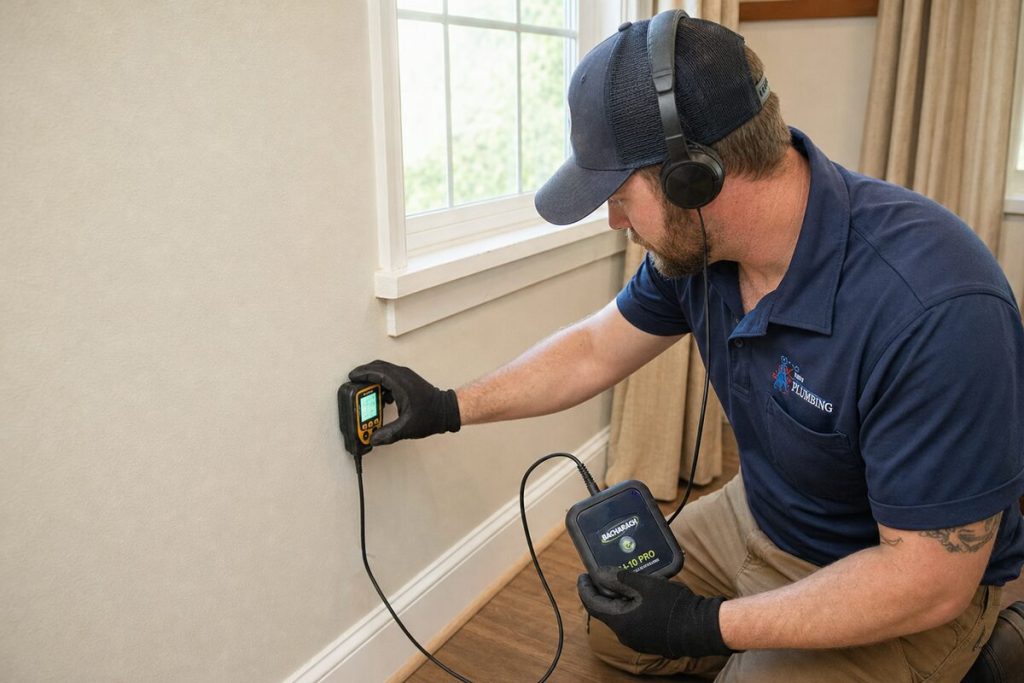
To find a water leak in your house, first confirm there is one with a meter test: turn off every fixture and watch the meter’s leak indicator. Next, work out whether the leak is inside or outside the house by closing the main shut-off valve. Then check the usual suspects room by room. Most household leaks come from toilets, supply lines, the water heater, appliances or the AC condensate line. In Houston, a slab leak under the foundation is a real possibility too, and it needs professional detection equipment.
Signs you have a hidden leak
- A water bill that rose without any change in how you use water.
- Stains, bubbling paint or soft drywall, especially low on walls or on ceilings below bathrooms.
- A musty smell in one spot or inside one cabinet.
- Warm areas on a tile or concrete floor, or a water heater that seems to run all the time.
- The sound of running water when nothing is on.
- Cupping or lifting wood or laminate flooring, or loose tiles.
- Puddles or an unusually green patch in the yard between the meter and the house.
The EPA’s WaterSense program says leaks in the average home waste more than 9,300 gallons a year, and about 9% of homes have leaks wasting 50 gallons or more a day. Slow leaks are common and easy to miss.
Step 1: The water meter test
- Turn off every faucet, shower, sprinkler, ice maker, washer and dishwasher in the house.
- Find the meter. In Houston it’s usually in a box near the curb.
- Look at the leak indicator, a small triangle, star or wheel on the meter face. If it’s turning, water is flowing somewhere.
- For slow leaks, write down the reading, use no water for two hours (or overnight), and read it again. The EPA says any change probably means a leak.
Step 2: Inside or outside?
Close your home’s main shut-off valve, usually where the supply line enters the house or in the garage, and check the meter again.
- Meter stops: the leak is inside the house, after the valve.
- Meter keeps moving: the leak is between the meter and the house (the service line) or in an irrigation line. The line on your side of the meter is usually the owner’s responsibility, so check with your water utility.
Step 3: Check the usual suspects
| Source | How to check |
|---|---|
| Toilets | Put a few drops of food coloring in the tank. If color shows up in the bowl within about 10 minutes without flushing, the flapper is leaking (an EPA WaterSense test). Also check the supply line and the base for dampness. |
| Sinks and vanities | Empty the cabinet. Check supply lines, shut-off valves and the drain trap with a dry paper towel. Look for a swollen cabinet floor. |
| Showers and tubs | Check grout, caulk and the valve. Stains on the ceiling below or on the wall behind often point to a failed shower pan or valve. |
| Water heater | Look for rust or water in the pan, a dripping relief valve, or wet insulation. Many Houston homes have water heaters in the attic or garage, where leaks can go unnoticed. |
| AC condensate | Houston ACs run most of the year and produce a lot of condensate. Check the attic air handler’s drain pan, the float switch and the drain line. A ceiling stain near the return grille is a classic sign. |
| Washer, dishwasher, fridge | Pull the appliance out and check hoses, the ice maker line and the floor underneath. Rubber washer hoses crack with age. (More on appliance leaks.) |
| Roof and windows | Leaks that only show up after rain usually aren’t plumbing. Check the attic after a storm with a flashlight. |
Water travels along pipes, joists and the slab, so a stain doesn’t always sit directly under its source. Follow the wet trail uphill.
How to find a water leak in a wall
A leak inside a wall usually shows up as a stain, peeling paint, swollen baseboard or a musty smell low on the wall. To narrow it down without tearing out drywall:
- Work out what’s behind the wall. Leaks almost always sit near a fixture: the wall behind a shower valve, a toilet, a vanity, the washer box or the fridge’s ice maker line. A wall with no plumbing in it usually points to a roof, window or AC drain problem instead.
- Run one fixture at a time. If the stain grows or the spot gets damp only when the shower runs, the problem is more likely the drain or shower pan than the supply line, which is under pressure all the time.
- Use a moisture meter. An inexpensive pin or pinless meter lets you map how far the dampness spreads across the drywall and find the wettest point.
- Check from the other side. Look in the closet, cabinet or attic behind or above the wall, where it’s easier to cut a small inspection hole.
Professional leak detection adds thermal cameras, which show cooler wet areas, and acoustic listening equipment, so the opening can be made in the right spot the first time.
Slab leaks: a Houston problem
Most Houston-area homes sit on concrete slabs over expansive clay that swells when wet and shrinks during droughts. That movement stresses pipes buried in and under the slab. Signs of a slab leak:
- A warm spot on the floor (hot-water line);
- Hissing or running water under the floor when everything is off;
- Flooring that lifts, or carpet that’s damp with no visible source;
- A meter that keeps turning after you’ve ruled out every fixture.
You can’t find a slab leak by eye. A plumber or leak-detection company uses acoustic listening equipment, thermal imaging, line pressure tests and sometimes tracer gas to pinpoint the spot before cutting the slab or rerouting the line.
Freeze damage
Houston doesn’t freeze often, but the February 2021 winter storm burst pipes across the region, often in attics and exterior walls. Some of those leaks only showed up when the water came back on. If you’ve had a hard freeze, check the attic and exterior walls when water pressure returns. (See burst pipe water damage.)
When to call a professional
- The meter shows a leak and you can’t find it.
- You suspect a slab or wall leak.
- The leak has already wet drywall, cabinets or flooring.
Finding and fixing the leak is a plumber’s job. Drying what the leak soaked is a separate job. The EPA advises drying water-damaged materials within 24–48 hours to prevent mold. Leaks that have run for weeks usually mean opening walls, checking for mold, and professional drying. Insurance often treats a sudden burst differently from slow, long-term seepage, so photograph what you find and read your policy before you call it in.
Found the leak, and the damage too? Call (713) 422-2550 and we’ll connect you with an independent Houston water damage company to dry it out.
Frequently asked questions
How do I find a water leak in my house?
Turn off all water and watch the meter’s leak indicator. If it moves, close the main shut-off to see whether the leak is inside or outside. Then check toilets, sink cabinets, the water heater, appliances and the AC condensate drain.
How do I find a water leak inside a wall?
Start with the plumbing behind the wall: shower valve, toilet, vanity or washer box. Run fixtures one at a time and map the damp area with a moisture meter. A professional can pinpoint it with thermal imaging and acoustic equipment before opening the wall.
How can I tell if I have a slab leak?
Warm spots on the floor, the sound of running water under the slab, damp flooring with no visible source, or a meter that keeps moving after every fixture is ruled out. A professional confirms it with acoustic or thermal detection.
How do I check a toilet for a leak?
Add a few drops of food coloring to the tank and wait about 10 minutes without flushing. Color in the bowl means the flapper is leaking.
Why is there a water stain on my ceiling under the attic?
In Houston, the most common cause is the AC: a clogged condensate line or a full drain pan under the attic air handler. Roof leaks and attic water heaters are the next places to check.
Can a water leak cause mold?
Yes. Materials that stay wet for more than a day or two can grow mold, so dry the area quickly once the leak is fixed.
Sources: EPA WaterSense: Fix a Leak · EPA: Mold, Moisture and Your Home
Water damage in your home right now?
Don't wait for it to spread. Call and we'll connect you with an available local company.
Call (713) 422-2550More Houston water damage guides
Water spreading right now? Don't wait.
Every hour costs you more in damage. Call now and we'll connect you with a local crew.