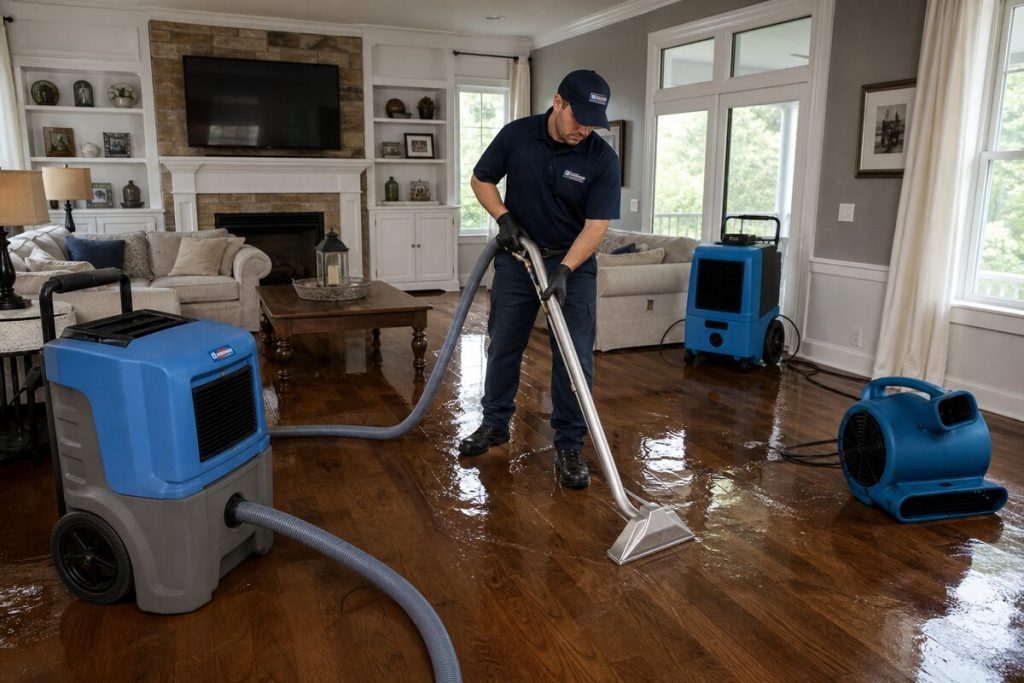
To remove flood water from a house safely: make sure the power is off and the water has stopped rising, put on boots, gloves and eye protection, pump or vacuum out the standing water, pull out wet materials that can’t be dried (carpet pad, soaked drywall, insulation), and then dry the structure with airflow and dehumidification until a moisture meter says it’s dry. Getting the water off the floor is usually the quickest part. Drying what soaked up the water takes much longer and matters more.
This is the hands-on version: tools, order of work, and where it stops being a DIY job. If you just discovered the water and haven’t secured the house or photographed anything yet, start with the first 24 hours after a flood, then come back here.
Before you start: four safety checks
- Electricity. Don’t step into water that could be in contact with outlets, cords, appliances or the panel. Only switch off the main breaker if you can reach it from a dry spot. If you can’t, have the utility disconnect power at the meter.
- Gas. If you smell gas, leave and call the gas company from outside. Floodwater can move appliances and stress gas lines.
- Contamination. Treat water that came from outside, a bayou or a sewer as contaminated (IICRC Category 3). Wear waterproof boots, rubber gloves and goggles. Keep children and pets out.
- Exhaust fumes. Never run a gas pump, pressure washer or generator inside the house or garage. Carbon monoxide builds up fast in enclosed spaces.
Step 1: Wait until outside water has gone down
If the water came in from the street or yard, pumping while it’s still rising outside just moves water in a circle. Wait until the outside level is below your slab or door threshold. If the source is inside, like a supply line or water heater, shut off the main valve first. Most Houston homes are slab-on-grade, so the water sits directly on the slab. Older pier-and-beam houses in neighborhoods like the Heights can also have water trapped in the crawlspace underneath, which needs its own drying plan.
Step 2: Get the standing water out
Use the right tool for the depth:
| Water depth | Tool | Notes |
|---|---|---|
| Several inches or more | Submersible utility pump with a discharge hose | Run the hose well away from the foundation and downhill, never into the sanitary sewer cleanout. |
| Under about 2 inches | Wet/dry shop vac | Empty it often; a full tank gets very heavy. Make sure the filter is rated for wet use. |
| A thin film on hard floors | Floor squeegee pushed toward a door or drain, then mops | Fast on tile and concrete. Less useful on carpet. |
| Wet carpet | Shop vac or a rented carpet extraction wand | Several slow passes. See whether the carpet can be saved before spending time on it. |
For more than a room or two, professional water extraction equipment like truck-mounted units and weighted extractors pulls water out of carpet and pad far faster than any shop vac.
Step 3: Remove what can’t be dried
Water wicks upward and soaks porous materials. The CDC’s flood cleanup guidance says to throw out anything that can’t be cleaned and dried within 24–48 hours, including carpet and pad that sat in floodwater, mattresses, upholstered furniture and paper goods, and to remove drywall and insulation contaminated by floodwater or sewage. Common practice is a “flood cut”: score the drywall in a straight line a foot or more above the highest wet point, remove everything below it, and pull out wet insulation behind it. That opens the wall cavity so air can reach the studs and bottom plate.
Photograph everything before it goes to the curb, and keep a small piece of each flooring type for your adjuster. Your insurer may also want to see large items before you get rid of them.
Step 4: Clean the surfaces you’re keeping
Scrub hard surfaces that were in floodwater, like studs, slab, cabinets you’re keeping and tile, with detergent and water, then rinse. If you use bleach, the CDC’s limit is no more than 1 cup of household bleach per gallon of water. Never mix bleach with ammonia or other cleaners. Clean first, then dry. Sealing dirty, wet wood behind new drywall is how mold gets trapped in a wall.
Step 5: Dry the structure, not just the room
This is where most DIY flood cleanup falls short. Here’s what actually dries a house in Houston’s humidity:
- Dehumidify. In a humid August, opening windows can let in more moisture than it removes. Once outside water is gone, close up, run the AC if it’s safe and the ducts weren’t flooded, and run dehumidifiers.
- Move air across wet surfaces. Aim fans low along walls and into opened cavities. Professional air movers are built to push air along a surface, which a box fan doesn’t do well.
- Measure. A pin or pinless moisture meter tells you when studs, bottom plates and the slab are actually dry. Feeling dry isn’t the same as being dry. Don’t rebuild until readings match an unaffected area of the house.
That last step is the core of structural drying: equipment is placed based on moisture readings, then readings are logged every day until the materials reach their dry targets.
Mistakes that make flood damage worse
- Running the HVAC system when floodwater reached the ducts or air handler. That spreads contamination through the house.
- Leaving wet baseboards and drywall in place “to see if it dries.” The bottom plate behind them stays wet.
- Using a household vacuum, or an extension cord lying in water.
- Rebuilding on a damp slab. New flooring traps moisture, and the problem shows up weeks later as cupping, odor or mold.
When to stop and call a professional
DIY is reasonable for a small amount of clean water caught quickly. It stops being reasonable when:
- the water came from outside or from a sewer (here’s why sewage is a different job);
- more than one or two rooms are wet, or water reached walls, cabinets or the HVAC;
- you can’t get moisture readings back to normal within a few days;
- you’re filing an insurance claim and need drying documented with readings.
Our DIY vs. professional guide goes through those calls in more detail.
Too much water to handle yourself? Call (713) 422-2550 and we’ll connect you with an independent Houston restoration company that has the extraction and drying equipment. Ask them to explain their moisture readings and their drying plan.
Frequently asked questions
What is the fastest way to remove flood water from a house?
A submersible pump for anything deeper than a couple of inches, then a wet/dry vac and squeegees for the rest. Professional truck-mounted extractors are faster still, especially on carpet.
Should I open the windows to dry a flooded house?
Only when the outside air is drier than the inside air. During much of Houston’s year it isn’t, so closing up and running dehumidifiers, plus the AC if the ducts weren’t flooded, usually dries a house faster.
How high should I cut drywall after a flood?
A common approach is to cut a foot or more above the highest point where the drywall is wet, then confirm with a moisture meter. Drywall and insulation that touched floodwater or sewage should be removed.
Can I use bleach on flood-damaged surfaces?
On hard, non-porous surfaces, yes. Clean with detergent first and use no more than 1 cup of bleach per gallon of water. Never mix bleach with ammonia. Bleach won’t fix wet porous materials like drywall, which need to come out.
How do I know the house is dry enough to rebuild?
Use a moisture meter on studs, bottom plates and the slab, and compare the readings with an area that didn’t get wet. Rebuild only once they match.
Sources: CDC: Cleaning safely after a disaster · CDC: Homeowner’s and Renter’s Guide to Mold Cleanup After Disasters (PDF) · EPA: Mold, Moisture and Your Home
Water damage in your home right now?
Don't wait for it to spread. Call and we'll connect you with an available local company.
Call (713) 422-2550More Houston water damage guides
Water spreading right now? Don't wait.
Every hour costs you more in damage. Call now and we'll connect you with a local crew.