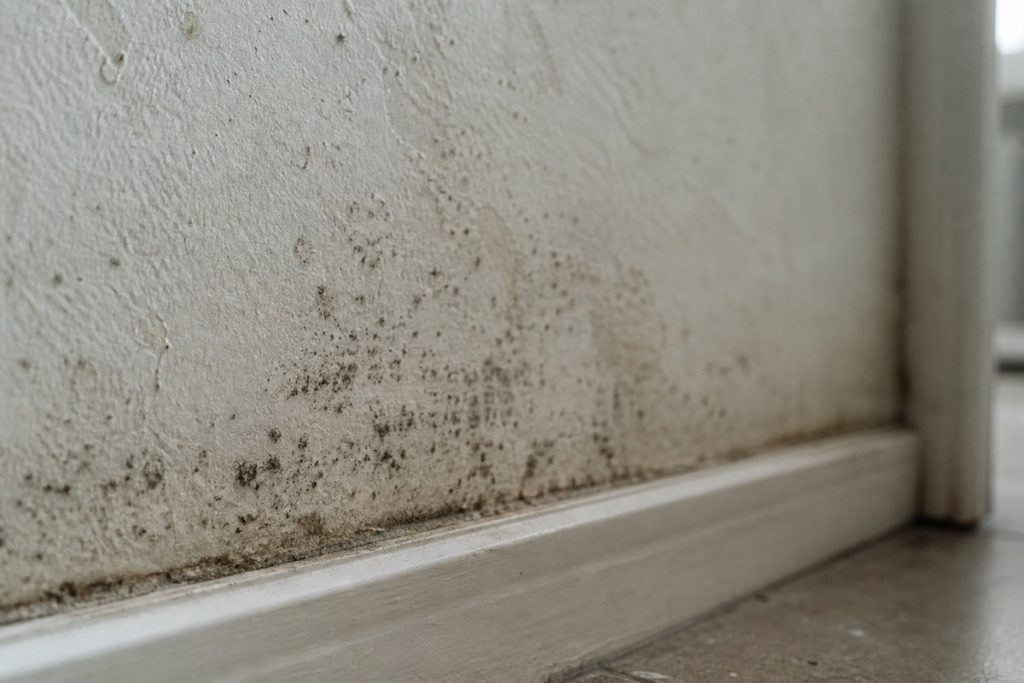
“Black mold” usually means Stachybotrys chartarum, a greenish-black mold that grows on materials with a lot of cellulose, like drywall paper, wood and cardboard, after they’ve stayed wet for a long time. “Regular mold” covers everything else. The CDC says the most common indoor molds are Cladosporium, Penicillium and Aspergillus, and many of those are dark too. You can’t tell the species by color, and according to the CDC and EPA the response is the same for any type: fix the moisture and remove the mold.
What does black mold look like?
Stachybotrys is typically dark greenish-black to black. When it’s actively growing on a wet surface it can look slimy or glossy. Once the material dries out it turns sooty or powdery. It usually grows in irregular blotches or speckled patches rather than a neat stain, and the most common places are:
- the paper face of drywall at the bottom of a wall that sat in water or behind a leaking pipe;
- the back of drywall, inside wall cavities, where you can’t see it until the wall is opened;
- ceiling drywall or tiles under a long-running roof or attic AC leak;
- wood framing, subfloor and cardboard that stayed wet for days or weeks.
It almost always grows on material that has been wet for a while. That’s the most useful thing about it as a clue: it points to a lasting moisture problem.
The catch is that many common molds also look black or dark green. Cladosporium, which often shows up on bathroom caulk, window frames and HVAC vents, is a frequent look-alike, and mildew on shower grout can look nearly black. Some dark stains aren’t mold at all, like soot from candles or water stains with dirt in them. Color, texture and location are clues, not a diagnosis. The only way to identify the species is a lab analysis of a sample. And as the CDC points out, the type doesn’t change what you need to do: any indoor mold growth should be removed.
Black mold vs. regular mold at a glance
| “Black mold” (Stachybotrys) | Common household molds | |
|---|---|---|
| Typical color | Greenish-black | Black, green, gray, white, blue-green, orange |
| Texture | Slimy when wet, sooty or powdery when dry | Fuzzy, powdery, or flat spotting |
| Where it grows | Cellulose materials wet for an extended time: drywall paper, wood, ceiling tiles | Almost anywhere damp: grout, caulk, window sills, AC vents, food, fabrics |
| What it tells you | Long-term water: a hidden leak or flood damage that wasn’t dried | Humidity or condensation, sometimes a leak |
| Can you identify it by eye? | No | No |
| What to do | Fix the moisture, remove the mold | Fix the moisture, remove the mold |
Is black mold more dangerous than other mold?
Some Stachybotrys strains can produce mycotoxins, which is where the “toxic mold” label comes from. According to the CDC, though, reports linking toxic indoor mold to rare conditions like pulmonary hemorrhage or memory loss are few, and a causal link hasn’t been proven. What the evidence does support, for any mold, is this:
- Mold can cause stuffy nose, sore throat, coughing or wheezing, burning eyes or skin rash in sensitive people.
- People with asthma or mold allergies can have more severe reactions.
- People with weakened immune systems or chronic lung disease can get lung infections from some molds.
So the practical answer is that black mold isn’t a special emergency compared with other molds, but no indoor mold growth should be left in place. The amount of growth and the people living in the house matter more than the species. (More on whether mold in your house is dangerous.)
Should you test to find out whether it’s black mold?
Usually not. The CDC doesn’t recommend routine mold testing, noting that sampling can be expensive, there are no set standards for what’s acceptable, and “no matter what type of mold is present, you need to remove it.” The EPA says that when mold is visible, sampling is usually unnecessary. Testing can be worth it when:
- you smell mold but can’t find it (it may be in a wall, crawlspace or ductwork);
- someone in the home has health concerns and a doctor wants more information;
- you need clearance documentation after remediation, or for a real estate deal.
In Texas, mold assessment for hire is a licensed activity regulated by TDLR. See mold inspection and testing for how it works.
What to do if you find black mold
- Don’t scrape or dry-brush it. Disturbing mold releases spores.
- Find and fix the water source. In Houston that’s often a plumbing leak, an AC condensate problem, a roof leak, or flood-damaged drywall that was never fully dried.
- Size it up. The EPA says homeowners can generally handle mold covering less than about 10 square feet. Hard surfaces can be scrubbed with detergent and water. Moldy porous materials like drywall and ceiling tiles usually need to be cut out and replaced.
- Know the Texas threshold. If you hire someone to remediate 25 contiguous square feet or more, Texas law requires a TDLR-licensed mold remediation contractor working from a protocol written by a separate licensed mold assessor.
- Don’t paint over it. The EPA notes that paint over mold is likely to peel, and the mold stays underneath.
Larger jobs are covered on our mold remediation page. Always ask any company you hire for its TDLR license number.
Dark growth on a wall after a leak or flood? Call (713) 422-2550 and we’ll connect you with an independent local company. For mold work, ask for its Texas license.
Frequently asked questions
What does black mold look like on drywall?
Usually irregular greenish-black or black patches, slimy if the drywall is still wet and sooty once it dries, often starting at the bottom of a wall or around a leak. Other molds and dirt stains can look similar, so only a lab test identifies the species.
How can I tell black mold from regular mold?
You can’t by looking. Many common molds are black or dark green. Only a lab analysis identifies the species, and the CDC says all indoor mold growth should be removed regardless of type.
Is black mold dangerous?
It can cause the same allergy and asthma symptoms as other molds, and it’s more of a concern for people with weakened immune systems or lung disease. The CDC says a link between “toxic” mold and rare illnesses hasn’t been proven.
What does black mold smell like?
Like most active mold growth: musty and earthy. A persistent musty smell with no visible mold often means growth inside a wall, under flooring or in the HVAC.
Can I remove black mold myself?
For small areas, under about 10 square feet on surfaces you can clean, the EPA says homeowners can usually handle it with gloves, goggles and an N95 respirator. Larger areas, contaminated drywall, or anyone in the home with health concerns call for a licensed professional.
Does bleach kill black mold?
On hard, non-porous surfaces, a solution of no more than 1 cup of bleach per gallon of water can be used (CDC). It won’t fix moldy drywall or wood, which usually need to be removed. Never mix bleach with ammonia.
Sources: CDC: About mold · EPA: Mold, Moisture and Your Home · TDLR: Mold program
Water damage in your home right now?
Don't wait for it to spread. Call and we'll connect you with an available local company.
Call (713) 422-2550More Houston water damage guides
Water spreading right now? Don't wait.
Every hour costs you more in damage. Call now and we'll connect you with a local crew.