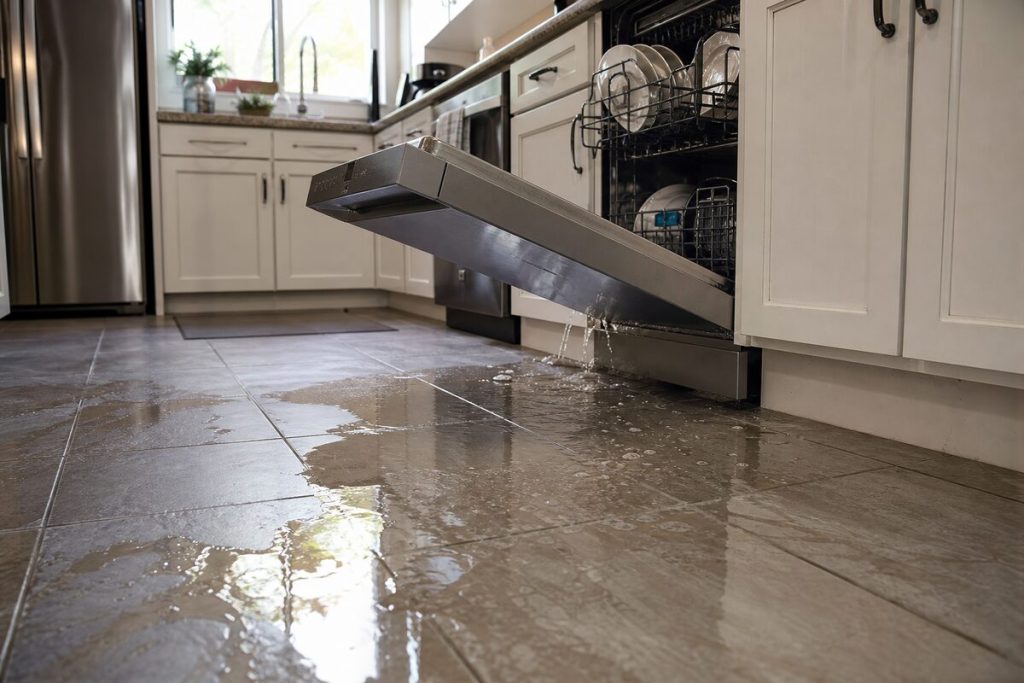
If your washing machine or dishwasher just flooded the floor, do three things in this order: stop the water, cut the power to the machine safely, and get the standing water up. Everything else, including figuring out why it leaked and whether insurance will help, can wait an hour. This guide walks through each step, the usual causes of a washing machine leak or dishwasher leak, how to dry things out, and the point where a mop and a fan stop being enough.
Step 1: Stop the water
Where the shutoff is depends on the machine:
- Washing machine: two valves (hot and cold) on the wall behind the washer, usually in a recessed box. Turn both clockwise until they stop. Single-lever boxes shut both with one quarter-turn.
- Dishwasher: a small valve under the kitchen sink, on the hot-water line, with a thin braided or copper line running toward the dishwasher. Turn it clockwise.
- Can’t find it, or the valve won’t turn? Shut off the water to the whole house at the main. Old valves that haven’t moved in years sometimes seize or start dripping when turned, so don’t force them.
If the washer is mid-cycle and overflowing, stopping or pausing the cycle can halt the fill, but close the valves anyway. A stuck inlet valve will keep filling no matter what the controls say.
Step 2: Cut power to the appliance
Washers and dishwashers sit right next to water and electricity. If the plug is above the water and your hands and feet are dry, unplug it. Dishwashers are usually hardwired or plugged in under the sink. If there’s any doubt, or water has reached an outlet, switch off the breaker for that circuit instead. Never reach into standing water to pull a plug.
Step 3: Get the water up fast
- Take photos and a short video first: the water on the floor, the machine, any visible hose or door damage. It takes a minute and it’s the evidence an insurer will ask for.
- Use a wet/dry vac if you have one; it pulls far more water than towels.
- Towels and a squeegee work for the rest. Push water toward a floor drain or out a door rather than spreading it.
- Lift rugs and move anything on the floor: boxes, laundry baskets, the bottom shelf of the pantry.
- Check the edges. Look under the adjoining cabinets, in the next room, and if the machine is upstairs, at the ceiling below.
Why did it flood? Common causes
Washing machine leak causes
- Burst fill hose. Rubber inlet hoses harden and crack with age. Whirlpool and Maytag both recommend replacing washer fill hoses every five years. A split hose releases water at full household pressure until someone closes the valve.
- Drain hose out of the standpipe. The washer vibrates the hose loose during the spin cycle and pumps drain water onto the floor.
- Clogged standpipe or drain box. Lint and soap build up until the drain can’t keep up and overflows at the wall.
- Too much detergent in a high-efficiency washer, which produces foam that pushes out of the door or drawer.
- Failed door seal, tub or pump on older machines.
Dishwasher leak causes
- Regular dish soap used in place of dishwasher detergent. It foams and pours out the door. This is the most common “sudden flood” with no broken part.
- Clogged filter or drain hose, so water backs up and overflows the tub.
- Worn door gasket or a door that isn’t latching fully.
- Leaking supply line or connection under the sink, which may drip for weeks before anyone sees it.
- Stuck float switch or inlet valve that lets the tub overfill.
Don’t run the machine again until you know which one it was. If a hose or valve failed, that’s a repair before the next load.
Can you dry it yourself?
Sometimes. The honest answer depends on where the water went and how long it sat.
| Situation | DIY is reasonable | Get it checked professionally |
|---|---|---|
| Water stayed on tile or sealed concrete, caught within minutes | Yes | No |
| Water reached carpet | Maybe, if it’s a small area and dried within a day | If the pad is soaked or it spread under walls |
| Water went under cabinets or the toe-kick | Rarely; it’s hard to dry a sealed space | Yes |
| Laminate, engineered wood or vinyl plank floors | Rarely; water gets under the boards | Yes |
| Upstairs laundry or the ceiling below is wet | No | Yes |
| The leak may have been going for days or weeks | No | Yes, and check for mold |
If you’re drying it yourself: run fans across wet surfaces, run a dehumidifier with doors closed, keep the AC on, and pull the kick plate off the bottom of the cabinets so air can get underneath. The CDC’s guidance after water damage is to dry things within 24 to 48 hours; materials still wet after that should be assumed to be growing mold. A cheap pin-type moisture meter is worth buying to check baseboards and cabinet floors after a few days rather than guessing.
Signs of hidden dishwasher or washer leak water damage
- Floorboards that cup, swell at the seams or feel soft.
- Cabinet bottoms that bubble or sag, especially the sink base next to the dishwasher.
- Baseboards that pull away from the wall or show a dark line.
- A musty smell a few days later, especially when the AC kicks on.
- Paint bubbling or a stain spreading on the ceiling under an upstairs laundry.
Any of these means water is trapped somewhere a fan can’t reach. That’s the point to get a moisture assessment. Our DIY vs. professional water damage guide covers the tradeoffs in more detail.
Will insurance pay?
The Texas Department of Insurance gives a broken washer hose as an example of the sudden and accidental water damage most homeowners and renters policies cover. Two common exclusions: damage from a leak that went on slowly over time, and the repair or replacement of the machine itself. Renters should check their own renters policy for their belongings; the building is usually the landlord’s policy. If you’re thinking about a claim, take photos before cleanup, keep receipts for anything you buy, and see our guide to homeowners insurance and water damage in Texas.
Prevent the next one
- Replace rubber washer hoses with braided stainless-steel ones, and still replace them on schedule.
- Leave some space between the back of the washer and the wall so hoses don’t kink.
- Put a washer pan with a drain under upstairs machines.
- Add inexpensive water sensors behind the washer, under the sink and next to the water heater, or an automatic shutoff valve.
- Don’t run the washer or dishwasher while you’re asleep or away from home.
- Clean the dishwasher filter regularly, and only use dishwasher detergent in it.
Water got under the cabinets or floors? Call (713) 422-2550 and we’ll connect you with an independent local company that can check for hidden moisture and dry it out. More on appliance leak water damage help.
Sources: Texas Department of Insurance · CDC: Homeowner’s and renter’s guide to mold cleanup · Maytag: washer fill hoses
Frequently asked questions
Is it safe to use my washing machine after it leaked?
Not until you know why it leaked. If it was a burst hose or a drain hose that popped out, fix that first. If water got into the controls or motor area, let it dry fully and have it checked before plugging it back in.
Why is my dishwasher full of suds and leaking?
Almost always the wrong soap: hand dish soap, or too much detergent or rinse aid. Scoop and wipe out the suds, then run a rinse-only cycle, repeating until the foam is gone.
How long do floors take to dry after a washer overflow?
Tile on a slab may be dry in a day with fans. Carpet, laminate and wood subfloors can take several days with a dehumidifier, and the moisture under them can take longer than the surface suggests.
Should I pull up my laminate floor after a leak?
If water got under the boards, usually yes, at least the affected rows. Laminate has a fiberboard core that swells and doesn’t go back, and the water underneath can’t dry with the boards in place.
Can a small dishwasher leak cause mold?
Yes, especially a slow leak under the cabinet that nobody sees. If you notice a musty smell or dark staining under the sink, have it checked.
Water damage in your home right now?
Don't wait for it to spread. Call and we'll connect you with an available local company.
Call (713) 422-2550More Houston water damage guides
Water spreading right now? Don't wait.
Every hour costs you more in damage. Call now and we'll connect you with a local crew.