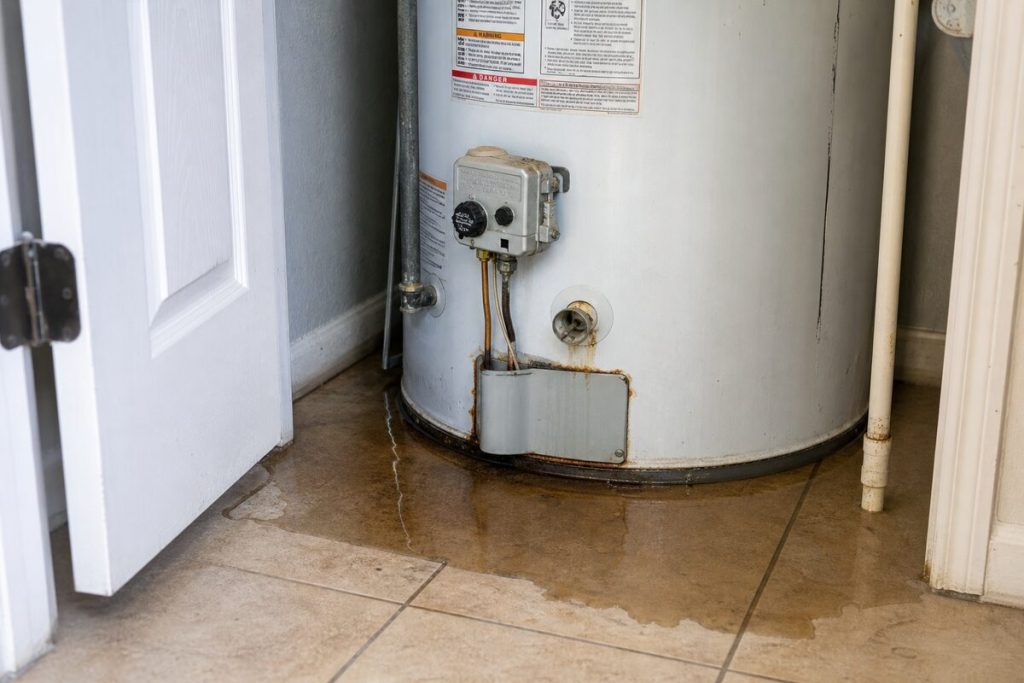
If your water heater is leaking, first shut off the cold-water supply to the tank, then turn off its power (electric) or set the gas control to “Off” (gas). Next, find where the water is coming from. A dripping relief valve, a loose fitting or a weeping drain valve can often be repaired. Water coming from the tank itself usually means the tank has rusted through and needs replacing. Then deal with the water on the floor before it soaks into drywall, cabinets and the slab.
Step 1: Shut it down safely
- Turn off the cold-water inlet. It’s the valve on the pipe going into the top of the tank (the cold side). Turn it clockwise. If it’s stuck or missing, close your home’s main water shut-off.
- Turn off the energy source.
- Electric: switch off the water heater’s double-pole breaker in the panel. Don’t touch the unit or the panel if you’re standing in water. Have the utility or an electrician cut power instead.
- Gas: turn the gas control knob to “Off” (or “Pilot” if you only want to stop heating), and close the gas shut-off valve on the supply line. If you smell gas, leave the house and call the gas company from outside.
- Relieve pressure if you need to drain it. Open a hot-water faucet somewhere in the house. If the tank itself is leaking, connect a garden hose to the drain valve at the bottom and run it to a floor drain or outside so the water goes where you choose.
- Be careful with hot water. Water in the tank and from the relief valve can scald. CPSC recommends a setting of 120°F to reduce scald risk, and many tanks are set hotter.
Step 2: Find where it’s leaking from
| Where you see water | Likely cause | Usually fixable? |
|---|---|---|
| Dripping from the discharge pipe on the side (T&P valve) | Pressure or temperature too high, thermal expansion in a closed system, or a worn valve | Yes, by a plumber. Never cap or plug the valve or its pipe. |
| Top of the tank, at the pipe connections | Loose fittings, corroded dielectric nipples, or a failed flex connector | Usually |
| Drain valve at the bottom | Valve not fully closed, worn washer, or sediment holding it open | Usually; the valve can be capped or replaced |
| Bottom of the tank, from under the jacket | The inner steel tank has corroded through | No. Replace the heater. |
| Water under a gas unit with no visible drip | Possibly condensation from the burner, especially with a cold tank refilling | Often normal if it stops once the tank heats up |
| Puddle near the heater but the heater is dry | A nearby supply line, the AC condensate line, or a washing machine | Check before blaming the tank |
About the T&P valve: it’s a safety device. Manufacturers such as A.O. Smith note that occasional discharge can come from thermal expansion when a check valve or pressure-reducing valve makes the plumbing a closed system. An expansion tank usually solves that. Constant discharge or a valve that won’t reseat needs a plumber. Don’t adjust it yourself, and never block it.
Step 3: Decide whether the tank is done
The U.S. Department of Energy puts the life of a conventional storage water heater at roughly 10–15 years, and a tankless unit at about 20. Replacement is usually the right call when:
- water is coming from the tank body itself rather than a fitting;
- you see rust-colored water from the hot taps or rust on the tank’s base;
- the unit is past about 10 years old and starting to leak;
- it rumbles or pops loudly from heavy sediment, which speeds up corrosion.
The manufacture date is coded in the serial number on the rating plate. The manufacturer’s website or a plumber can decode it.
Tankless water heaters are different
A tankless unit can’t dump 40–50 gallons on the floor, but it can leak at its water connections, at the pressure relief valve, from the condensate line on condensing models, or from a cracked heat exchanger. The shut-off steps are the same: close the isolation valves under the unit and turn off power and gas. Hard water and skipped descaling are common causes of trouble, so check the manufacturer’s maintenance schedule.
Houston notes: attics, garages and slabs
- Attic heaters. Many Houston homes have water heaters in the attic. A leak there runs through insulation and into ceiling drywall before anyone notices. The building code requires a drain pan piped to a safe spot where leakage would cause damage. Make sure yours exists and its drain line is clear. A ceiling stain near the heater’s location is a warning sign. (See ceiling water damage.)
- Garage heaters. Gas heaters in garages generally must have their ignition source at least 18 inches above the floor, unless the unit is listed as flammable-vapor ignition resistant. Leaks there usually run across the slab toward the house door and under drywall at the base of the shared wall.
- Interior closets on a slab. Water spreads under baseboards, carpet and laminate and wicks up drywall. Check the adjoining rooms, not just the closet.
Step 4: Deal with the water damage
A tank failure can put tens of gallons on the floor quickly, and a slow leak can soak a wall for weeks before anyone sees it. Either way, the plumber fixes the heater, but the water already in the building is a separate job:
- Photograph the heater, the leak point, the rating plate and the wet areas before cleanup. Insurers often treat a sudden tank burst differently from a long-term leak.
- Extract standing water and pull wet carpet pad. (See wet carpet.)
- Check walls, cabinets and the floor with a moisture meter. The EPA advises drying water-damaged materials within 24–48 hours to prevent mold.
- If water reached drywall, ceilings or another room, professional drying with air movers and dehumidifiers is usually worth it. More on appliance and water heater leak damage.
Water heater soaked the floor or ceiling? Call (713) 422-2550 and we’ll connect you with an independent Houston water damage company to extract and dry it.
Frequently asked questions
What should I do if my water heater is leaking?
Close the cold-water inlet valve (or the house main), turn off the breaker or set the gas control to off, then find the source. If water is pooling, drain the tank with a hose to a safe spot and start drying the area.
Can a leaking water heater be repaired?
Leaks from fittings, the drain valve or the relief valve can often be repaired. A leak from the tank body means the steel tank has corroded through, and the heater needs replacing.
Why is my water heater leaking from the pressure relief valve?
Usually excess pressure or temperature, often from thermal expansion in a closed plumbing system, or a worn valve. A plumber can test it and add an expansion tank if needed. Never cap or block the valve.
Is it safe to use a leaking water heater?
Not until the cause is known. Shut it down, especially if water is near the electrical connections or burner, and have a plumber check it.
Is water under a gas water heater always a leak?
Not always. Gas units can produce some condensation, especially when refilling with cold water, and it usually stops once the tank is hot. If water keeps collecting, look for a real leak.
Does homeowners insurance cover water heater leaks?
Policies often cover sudden water damage from a burst tank but not the heater itself or damage from a long, slow leak. Read your policy and document everything. See our Texas insurance guide.
Sources: U.S. DOE Energy Saver: Water heating · A.O. Smith: Leaking T&P valve bulletin · CPSC: Tap water scalds (PDF) · Houston Residential Code, Ch. 28
Water damage in your home right now?
Don't wait for it to spread. Call and we'll connect you with an available local company.
Call (713) 422-2550More Houston water damage guides
Water spreading right now? Don't wait.
Every hour costs you more in damage. Call now and we'll connect you with a local crew.