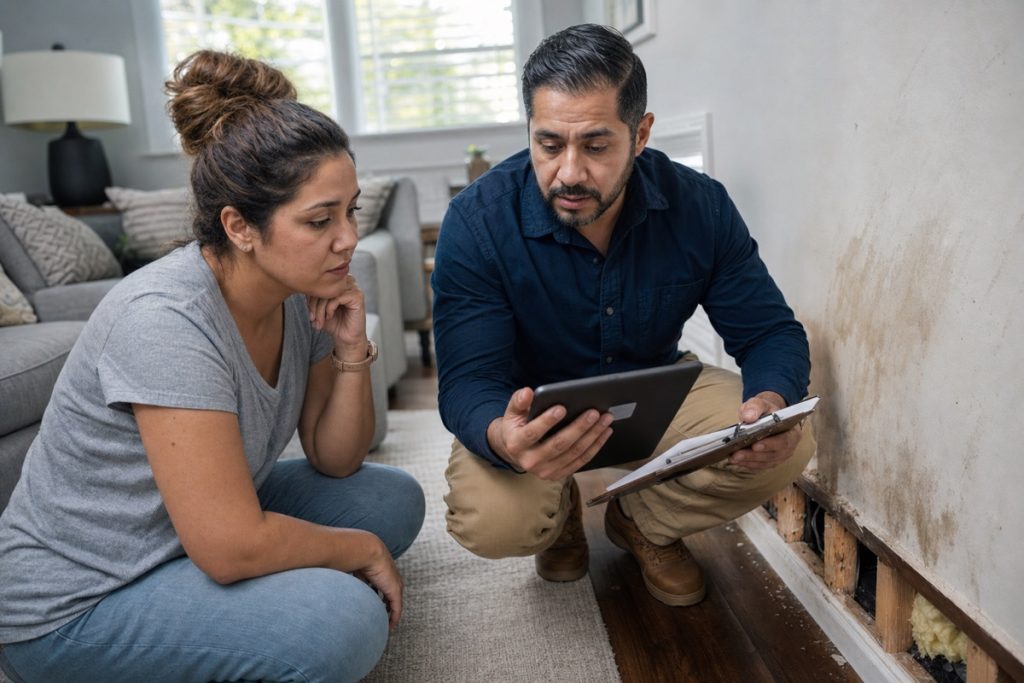
Usually yes, if the water came from a sudden and accidental source inside the house. Usually no, if it came from rising water outside or from a leak that went on for weeks. That one distinction decides most Texas water damage claims, and it is the same rule the Texas Department of Insurance (TDI) explains to consumers: home and renters policies cover sudden and accidental water damage such as a burst pipe, an overflowing toilet or a broken washer hose, but generally not gradual leaks, seepage or flood.
This is general information, not legal advice or a coverage decision. Policies differ. Your declarations page and policy wording control, so read them or ask your agent.
What “sudden and accidental” covers
These are the losses Texas homeowners policies are built for:
- A supply line, pipe or fitting that bursts, including pipes that froze, as thousands did across the Houston area during the February 2021 winter storm.
- A water heater tank that ruptures.
- A washing machine, dishwasher, ice maker or refrigerator line that breaks.
- An accidental overflow from a toilet, tub or sink.
- Rain that enters through an opening created by wind or hail damage to the roof or walls.
The covered portion usually includes the resulting damage (wet drywall, flooring, cabinets) and the reasonable cost of drying it out. The part that failed, such as the worn-out water heater itself, is often not covered; the water it released is. Many policies also pay to open a wall or floor to reach the broken pipe and close it again.
What is usually excluded
Flood (rising water from outside)
Standard homeowners policies exclude flood: overflowing bayous and creeks, storm surge, and surface water flowing into the house. That gap matters in Harris County, where Hurricane Harvey in 2017 and Tropical Storm Allison in 2001 flooded many homes outside mapped high-risk zones. Flood coverage comes from a separate policy, either through the National Flood Insurance Program (NFIP) or a private flood insurer.
Two NFIP rules catch people out. There is typically a 30-day waiting period before a new policy takes effect, so buying one when a storm is already in the Gulf usually comes too late. And after a loss, NFIP policyholders generally must submit a signed proof of loss within 60 days. Our guide to Houston flood zones covers how to check your risk.
Wind in coastal areas
For homes in the 14 first-tier coastal counties (including Galveston, Brazoria and Chambers) and in parts of Harris County east of State Highway 146 within La Porte, Morgan’s Point, Pasadena, Seabrook and Shoreacres, many homeowners policies exclude wind and hail. That coverage is bought separately, often from the Texas Windstorm Insurance Association (TWIA). If storm rain came in through wind damage and you live in that area, the claim may belong to TWIA rather than your homeowners carrier.
Gradual leaks, seepage and wear
A slow drip under a sink, a shower pan that has leaked into the subfloor for months, or water wicking through a slab is generally excluded as continuous or repeated seepage, wear and tear, or deterioration. The insurer’s adjuster will look for signs of age: rot, layered staining, rusted fasteners, established mold.
Mold from excluded water
TDI notes that mold resulting from a sudden, covered water loss is generally covered, but mold from a flood or from a long-running leak generally is not. Many policies also cap mold payments at a set dollar amount.
The gray areas
Sewer and drain backup. Water that backs up through floor drains, toilets or tubs from the municipal sewer is excluded from many base policies unless you added a water backup endorsement. Check before you need it. See sewage backup cleanup for why this is also a health issue.
Slab leaks. Houston’s expansive clay soils move, and plumbing under slab foundations does fail. Some Texas policy forms include specific coverage for tearing out and replacing part of the foundation to reach a leaking pipe; others do not. This is worth asking your agent about by name.
“Ensuing loss” disputes. If a slow leak finally gave way and released a lot of water at once, the insurer may cover the sudden discharge and deny the older damage. Good photos and moisture readings help separate the two.
Quick reference
| Situation | Usually covered by homeowners policy? |
|---|---|
| Burst or frozen pipe | Yes |
| Water heater rupture | Water damage yes; the heater itself often no |
| Appliance hose or supply line failure | Yes |
| Rain through wind or hail damage | Usually; coastal wind may be excluded and covered by TWIA |
| Rising floodwater or storm surge | No; needs flood insurance |
| Long-term leak or seepage | Usually no |
| Sewer or drain backup | Only with a backup endorsement, in many policies |
| Mold | Sometimes, if it resulted from a covered sudden loss; often capped |
Your duties after a loss
Policies require you to protect the property from further damage. That means stopping the water, starting drying, and keeping receipts. Failing to mitigate can reduce what the insurer pays. Practical steps:
- Shut off the water and, if safe, the power to wet areas.
- Photograph and video every affected room before anything is moved.
- Report the claim promptly and write down the claim number.
- Keep damaged items until the adjuster has seen or approved disposal of them, or document them thoroughly.
- Get the restoration company’s moisture readings, photos and itemized estimate in writing.
If you need a company to start drying, call (713) 422-2550 and we’ll connect you with an independent local restoration company. Ask them for proof of insurance and IICRC certification before work begins. If a contractor asks you to sign an assignment of benefits, read our assignment of benefits guide first so you know what you would be signing over.
Deadlines insurers must meet in Texas
The Texas Prompt Payment of Claims Act (Texas Insurance Code chapter 542) sets timelines once you report a claim, including 15 days to acknowledge it and start the investigation, and 15 business days to accept or reject it after receiving everything it asked for. The step-by-step version is in our guide to filing a water damage claim in Texas. If your claim is turned down, read what to do when a water damage claim is denied.
Where to get help
TDI runs a Consumer Help Line at 800-252-3439 and accepts complaints online. It cannot act as your lawyer, but it will contact the insurer, review how the claim was handled and check whether state law was followed.
Sources: TDI: water damage and home insurance · TDI: homeowners complaint help · FEMA: flood policy waiting period · TWIA FAQs
Frequently asked questions
Does Texas homeowners insurance cover a burst pipe?
Generally yes. A burst or frozen pipe is a sudden and accidental discharge, which is what TDI describes as covered by home and renters policies. Your deductible still applies.
Is flood damage from Harvey-type rain covered by homeowners insurance?
No. Rising water and surface flooding are excluded from standard homeowners policies. You need a separate NFIP or private flood policy, and NFIP policies typically have a 30-day waiting period.
Will my insurer pay for mold after a leak?
Often only if the mold resulted from a covered, sudden water loss, and many policies cap mold payments. Mold from long-term leaks or flooding is generally excluded.
Who covers wind-driven rain in La Porte or Seabrook?
If your home is in the TWIA coverage area, your homeowners policy may exclude wind and hail, and that portion of the claim would go to your TWIA policy instead.
Is a sewer backup covered?
In many Texas policies, only if you purchased a water or sewer backup endorsement. Check your declarations page or ask your agent.
Water damage in your home right now?
Don't wait for it to spread. Call and we'll connect you with an available local company.
Call (713) 422-2550More Houston water damage guides
Water spreading right now? Don't wait.
Every hour costs you more in damage. Call now and we'll connect you with a local crew.